Table of Contents
- What This Tradition Is
- Who the Ingvaeones Were
- An Honest Word About Reconstruction
- The Scope of Our Sources
- Why We Practice: The Threefold Goal
- How We Practice: Folcsida and Fyrnsida
- Where to Go From Here
What This Tradition Is
Ingƿina Hæðenscipe — Ingwine Heathenship — is a modern polytheistic and animist religion rooted in the pre-conversion customs of the North Sea Germanic peoples: the Angles, Saxons, Jutes, Chauci, Frisians, and their neighbors along the shores of the North Sea and the Low Countries. It is a living tradition — reconstructed from primary sources, grounded in scholarship, and practiced by real communities today.
The name comes from the Old English Ingƿine, meaning the “Friends of Ing” — a term attested in Beowulf and rooted in Tacitus’s Germania, where he records that the coastal Germanic peoples traced their lineage to Ing, son of Mannus, son of the earth-born god Tuisto. We are the spiritual and cultural descendants of those peoples, regardless of genetic heritage. Any person who approaches this tradition with sincerity and good faith is entitled to call themselves an Ingwine.
We use the terms Heathenry and Heathenship interchangeably, though we prefer Heathenship — it is an attested English word and translates the Old English hæðenscipe more exactly.
Who the Ingvaeones Were
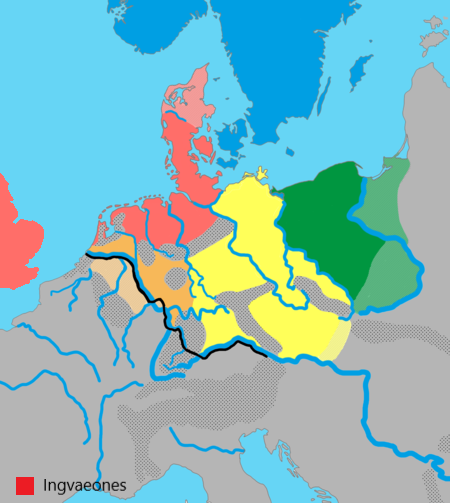
The Roman scholar Tacitus, writing in Germania around 98 CE, records that the Germanic peoples traced descent from three sons of Mannus: Ing, Irmin, and Itaev. From Ing came the Ingaevones — the peoples of the North Sea coast. If we strip the Latin suffix, we have Ingƿine: the Friends of Ing.
Interestingly, in Beowulf, an epic written in Old English, we see that Hrothgar is repeatedly referred to as a “lord of Ing’s Friends”. This shows us two things. First, that the English, whose own name seems to invoke descent from Ing (Pollington, 2011) had such a term in their lexicon, and also that the poet felt it appropriate to apply it to a king of the Danes. This would possibly indicate that the Heathen Danes, as protagonists in the story are being afforded the “courtesy” of not being called out as Heathens by the Christian poet, but certainly it is the case that the dynasties of West-Germanic kings and nobles and their North-Germanic cousins were intertwined in ways we will probably never be able to clearly discern now. The genealogies offered for Hrothgar and those of ancient Angeln seem to lay claim at times to the same kings, including the mythological hero Sceafa, from whom both Hrothgar and the later kings of the Angles claim descent. Suffice to say, that the accounts of Danish and English royal dynasties of pre-conversion times are muddled and contradictory at best, and when we speak of the Ingwine here, it is not the Danes but the West-Germanic, or Ingavaeonic language family we speak of.
These peoples — Angles, Saxons, Jutes, Chauci, Frisians — inter-communicated, traded, and were for the most part mutually intelligible. They share a language family that linguists call Ingvaeonic or North Sea Germanic, ancestral to Old English, Old Frisian, and Old Saxon, and through them to modern English, Dutch, Frisian, and Low German. This linguistic and cultural boundary defines the scope of our tradition. It is broad enough to yield a workable body of lore. It is narrow enough to remain coherent.
Our primary focus is the Anglo-Saxon English tradition, as the most richly documented of these cultures, with the Frisian and Low Saxon traditions as close companions. We draw on broader Germanic sources where necessary, but sparingly, and always with attention to whether a given practice would have been recognizable to the peoples at the center of our tradition.
An Honest Word About Reconstruction
The conversion of the English, Frisian, and Saxon peoples to Christianity, combined with the passage of more than a thousand years, has left the surviving record of their Heathen practices fragmentary. Timber temples have rotted. Oral traditions were broken or written down in ways that obscured their origins. A comprehensive reconstruction of Iron Age West Germanic religion is not possible, and anyone who claims otherwise is not being honest with you.
What is possible — and what is already underway — is a revivification: a living tradition built on what we do have, shaped by rigorous engagement with primary sources, and honest about the difference between what is attested, what is reconstructed, and what is frankly modern. Throughout this Lorehoard, that distinction is maintained. Well-attested beliefs and practices carry more weight than those which are not. Where we have filled gaps or made modern adaptations, we say so, and explain why.
This tradition is not historical reenactment. It is not a museum piece. It is a religion — practiced now, by living people, in real communities.
The Scope of Our Sources
Our primary period of interest runs from the 1st Century CE through the 9th. Within that span we give greatest weight to the pre-conversion and early conversion period in England and the North Sea Germanic world. Folk customs surviving into the 6th through 9th centuries are included where they can be assessed as genuinely Heathen in origin.
From the 10th century onward we exercise increasing skepticism — but it is important to say precisely what that skepticism is and is not about.
It is not about temporal distance from some imagined point of purity. Heathenry in Frisia in the 2nd century CE is not inherently more authentic than Saxon religion in Britain in the 5th, or Frisian folk practice in the 9th. Each reflects a living tradition at a particular time and place within the Ingvaeonic world. Earlier is not automatically better. It is simply different, and differently evidenced.
The real criterion is the nature of the transmission. Sources require skepticism when they passed through filters that systematically distorted or suppressed the material they recorded. The primary such filter is the Christian literary tradition — not because Christian writers were dishonest in general, but because they were observing, and usually condemning, practices they did not share and often did not understand. Snorri Sturluson’s Prose Edda is treated with caution not simply because it was written in the 12th century, but because it was written by a Christian scholar attempting to systematize Norse mythology into a literary framework shaped by classical and Christian categories. The distortion is interpretive, not merely temporal.
Folk traditions are a different case entirely. A harvest custom recorded in 19th century rural Germany, invoking recognizable Heathen figures for recognizable Heathen reasons, transmitted within a living community across generations, may preserve something genuinely continuous with pre-Christian practice — more so, in some cases, than a medieval literary text written by an educated outsider. The date of recording is not the date of origin. Oral and customary transmission within a community is not the same thing as literary reconstruction at a remove. Such traditions are evaluated on the evidence of their continuity with attested practice, not dismissed because they were written down late.
What we are skeptical of, in summary, is not lateness per se but distortion — the reshaping of genuine Heathen material through hostile, syncretic, or systematizing lenses that cannot be fully accounted for. Where that distortion can be identified and set aside, late sources and even contemporary folk traditions remain valuable. Where it cannot, we proceed with appropriate caution and say so plainly.
Why We Practice: The Threefold Goal
Ingwine Heathenship is not primarily an intellectual exercise, though it demands intellectual honesty. It is a religion, which means it is practiced — in daily life, in community, in relationship with the Gods, the Ancestors, and the spirits of the land.
The why of that practice is expressed in what we call the Threefold Goal: the cultivation of hælu (health and wholeness), freod (peace and community), and gástdóm (spiritual devotion). These three aspirations are the motivating logic of everything that follows in this Lorehoard. They are not a checklist. They are a compass.
How We Practice: Folcsida and Fyrnsida
The Folcsida — our enumerated living customs — are the principle pillars of our practice.
They are rooted in the Fyrnsida — literally “the Old Ways” — the body of pre-conversion customs we can attest through primary sources: worship in sacred groves, veneration of the Earth, the obligations of hospitality, the conduct of sacrifice, offerings at wells and prominent natural features. These are the customs our ancestors practiced. They are not invented. They are documented, examined, and where necessary carefully reconstructed from the surviving evidence.
The Folcsida are the Fyrnsida made living — received, interpreted, and practiced now by real communities in the present.
Where to Go From Here
This page is the door. Behind it lies the Lorehoard, our living collection of research and teachings. The suggested path for someone new to the tradition is:
Threefold Goal → Folcsida → then wherever your interest leads you.
If you are looking for something specific, you can look at the alphabetized archive, browse the Lorehoard by tag, or consult the Bibliography for the primary and secondary sources that underpin these teachings. You may want to discover more about our rites, our seasonal holidays, or the Gods. These “tags” can always be explored using the sub-menu under Lorehoard, on the main menu.