Table of Contents
- Our Mission
- How we are Organized
- Membership
- Our Clergy
- Reserved Titles
- Clergy training and Congregation Formation
- Support Us
Our Mission
The goals of the Ingvaeonic Society, or as we like to call it in the Anglo-Saxon language, Ingwina Ferræden, are to:
- promote the teachings of Ingwine Heathenship
- promote the study and preservation of West Germanic languages and culture
- develop, network, and support local religious fellowships
- provide educational and emergency support to members and member fellowships
- provide sacerdotal services such as officiating of weddings, funerals and rites of passage
- organize community events centered around Ingwine Heathenship
- support charitable and environmental causes consistent with the beliefs of Ingwine Heathenship
How we are Organized
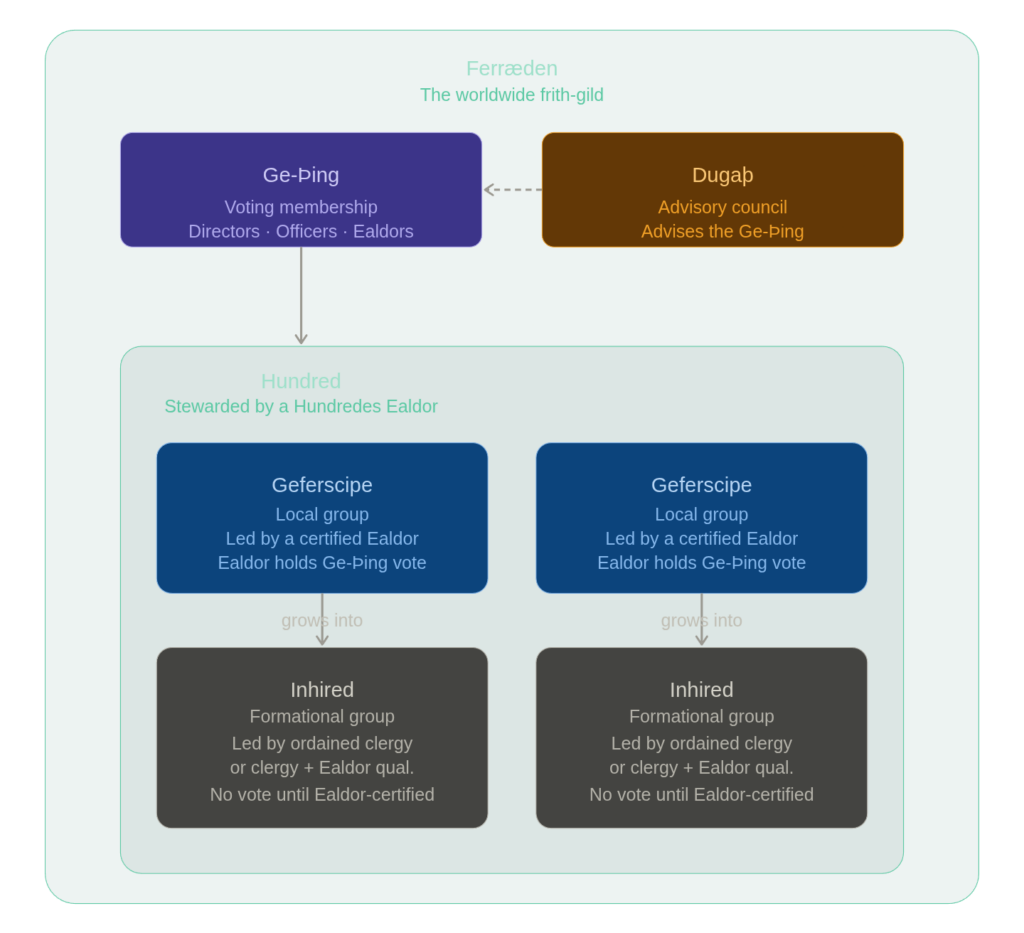
The Ingwina Ferræden is organized as a Friðgild—a peace-guild, in the manner of the ancient Germanic tradition—a voluntary sworn fellowship of local communities united by shared faith, mutual obligation, and the bonds of friþ. Rather than functioning as a top-down ecclesiastical body, the Ferræden operates as a confederation of kindreds and férscipas, each largely autonomous in its local affairs, but bound together through common tenets, a governing compact, and the shared responsibilities of membership. Each férscipe is represented in the governing body of the Ferræden by an Ealdor-sacerd (High Priest/ess), who serves as both its administrative and spiritual leader.
The Ingwina Ferræden — known in English as the Ingvaeonic Society — is a 501(c)3 non-profit organized as a Friðgild: a peace-guild in the ancient Germanic tradition, bound by mutual obligation, shared faith, and the pursuit of friþ. Everything below belongs to it.
The Ge-Þing is the voting body — the governing college of the organization. Membership consists of the Directors (who also constitute the corporate Board of Directors), Officers of the organization, and all serving Ealdors. If you lead a recognized local group with full Ealdor credentials, you have a seat and a vote.
The Dugaþ sits alongside the Ge-Þing as its advisory council — a select body of thought leaders and subject-matter experts. It does not vote; it advises the Ge-Þing directly.
The regional structure is organized into Hundreds. A Hundred is a geographic territory stewarded by a Hundredes Ealdor — a service role, not a rank above local leaders. The Hundredes Ealdor ensures the region has a living rhythm: at least one major gathering per year, connection between scattered members, and support for new groups as they form. Their own seat on the Ge-Þing comes from their Ealdor certification, the same as any other Ealdor.
Within each Hundred are Geferscipes — the tight-knit local groups, each led by a certified Ealdor who represents the group on the Ge-Þing.
A Geferscipe in formation is called an Inhired. Because the Ingwina Ferræden is a church, religious ordination comes first: an ordained clergy person may lead an Inhired without additional qualification. To become a full Ealdor — and thus lead a recognized Geferscipe with a Ge-Þing vote — that clergy person must also hold the Ealdor qualification. No ordination, no Ealdor. No Ealdor, no vote.
Membership
If you are interested in becoming a part of the Society, you can learn about that process here. There are essentially three tiers of membership in the Ferræden:
Undocumented Member (Gingra/Gingre)
This category of members is basically the believers of our religion, at-large. These are people who have embraced the teachings of Ingwine Heathenship , whether they are part of an existing kindred group or not, and they have no official standing with the organization, nor any formal connection beyond shared beliefs. As such, this is not considered a “rank” at all, but simply a term to designate our co-religious, who have not opted to formalize their relationship with the organization. We call such a person gingra if masculine or gingre if feminine, a term meaning ‘disciple’.
Confirmed Non-Voting Member (Gesiþ/Gesíþwífe)
A person who has taken and passed our lore exam and registered with the global organization is called agesíþ (masculine) or gesíþwífe (feminine), an Old English title meaning ‘Companion’. These people are the backbone of our Ferræden, and it is from this category of members that the organization draws candidates for office, and for ordination as ministers. In other religions, these would be the people who are considered “confirmed” or “baptized”.
Voting Member (Rǽdend)
The high Priest or Priestess of every affiliated ferscipe, as well as the officers and board of directors of the organization, are voting members. The style rǽdend or alternatively, rǽdesmann applies collectively to any of these people.
Our Clergy
The term “Sacerdhad” encapsulates the entirety of the Ingwine Heathen clergy, encompassing both ordained and unordained individuals devoted to the community’s spiritual pursuits. This collective body collaborates to uphold and propagate the traditions and beliefs integral to the Ingwine Heathen faith.
The Sacerdhad forms an organized priesthood dedicated to fulfilling the spiritual needs of the Society. This collective body operates with a profound commitment to the community, offering a range of essential services. Central to their role is the performance of rites, ceremonies, weddings, and funerals, providing a spiritual foundation for the Society. Beyond these ceremonial duties, members of the Sacerdhad serve as counselors, offering guidance and support to individuals within the community. Additionally, they assume the role of thought leaders, contributing to the intellectual and philosophical dimensions of the Society’s belief system. In essence, the Sacerdhad embodies a multifaceted and essential function within the community, acting as both custodians of tradition and pillars of support for its members.
Sacerd:
A Sacerd is simply a member of the Sacerdhad. This is not a title, per se but an Old English word meaning essentially, “priest”, and could be referring to a member of any religion.
Ealdor (Leader of the Congregation):
The Ealdor stands as the esteemed leader of the congregation, holding a pivotal role in both spiritual and organizational dimensions. This individual bears the responsibility of guiding and overseeing the entire local community, ensuring the continuity and vitality of Heathen practices.
Heargweard (Ordained Minister):
Within the clergy, the Heargweard or ‘Temple Warden’ assumes the valued position of an ordained minister. Charged with conducting sacred ceremonies, providing spiritual counsel, and exhibiting leadership, the Heargweard plays a central role in fostering the religious life of the community.
Æweard (Apprentice or Unordained Helper):
The Æweard serves as an integral part of the Heathen clergy, embodying an apprentice role. This unordained individual has chosen to assist in ceremonial activities, actively participating and learning under the guidance of ordained clergy. The quasi-title “Æweard” represents the commitment of individuals aspiring to deepen their understanding and involvement in Heathen practices.
Reserved Titles
Just as other faiths have titles and styles such as “Reverend” or “Pastor”, we have reserved a few such terms, that we ask people associated with us not to self-apply, as the organization gives them official standing. These are:
| Purpose | Title | English Title |
|---|---|---|
| The High Priest of a Kindred Group | Ealdorsacerd, Ealdor (Frisian: Âlder, Dutch: Ouderling) | Elder Priest/ess |
| A confirmed follower of the faith | Gesíþ and Gesíþwíf (Dutch: Gezel) | Companion |
| An ordained cleric | Heargweard (Dutch: Hargwaard) | Temple Warden |
| An member of the lay clergy | Æweard (Dutch: Wetwaarder) | Warden |
We also commonly employ a number of ancient terms for administrative or ritual roles, such as blotere ‘one who leads a sacrifice’, which are NOT reserved and are simply traditional ways to describe a person who does a certain thing.
Clergy training and Congregation Formation
Every path in the Ingwina Ferræden begins at the same place. A Gingra is an associate member — someone exploring the tradition without formal commitment. It is the entry point, and it is where everyone starts.
From there, a Gingra who commits fully becomes a Gesith — a full, non-voting member of the organization. Gesith membership is not a formality. It is a prerequisite for everything that follows. There is no path to ordination that bypasses it.
A Gesith in good standing may apply for ordination. Ordination is the foundational religious credential of the Ingwina Ferræden. Because the organization is a church, it comes before everything else. An ordained clergy person may immediately begin Ealdor training — the additional qualification required to lead a recognized congregation with voting rights — and may also begin forming a congregation.
The smallest valid congregation is an Inhired: a formational group consisting of the ordained clergy person and at least one other individual. An Inhired is not yet a full Geferscipe, and its leader need not be Ealdor-certified. It is the seed form — a real community, but still on the path.
When an ordained clergy person completes Ealdor training and holds at least one Gesith alongside them, that group may constitute a full Geferscipe. At that moment, the clergy leader becomes a certified Ealdor and takes their seat as a voting member of the Ge-Þing, representing their congregation in the governance of the Ingwina Ferræden.
Our official policy on the creation of local congregations and the training and ordination of clergy, is here.
Support Us
Our organization us largely funded by donations. To support our organization with a donation, please use the button below, and thank you!