Table of Contents
- Living Heathenship every day
- Everyday acts of devotion
- Sacred steps: walking as devotion
- Conclusion: begin with the path under your feet
Living Heathenship every day
A lot of people come into Heathenry asking what they’re supposed to do. Where’s the ritual calendar? Who leads the blót? What should I offer the gods? These are good questions. But there’s another one—quieter, more pressing: What does it look like to live as a Heathen when there’s no ritual happening?
One of the weaknesses of modern pagan revivalism in general is that it’s often overly focused on ritual events. Gatherings. Feasts. Offerings. While these are essential, they are not the whole path. A religion cannot survive if it’s only practiced a few times a year.
Heathenry is meant to be lived. And to live it, we need a concept that captures what it means to walk in spiritual alignment—not just during blót, but every day. That concept is bigang.
What is bigang?
The word bigang is Old English. Literally, it means a going about, a walk, a journey, or a course of conduct. You’ll find it in various contexts—legal, social, even poetic. In Old English texts, a bigang might describe a physical circuit or procession, like the course of the sun (sunnan bigang), or the orbit of a heavenly body. But it can also mean something more abstract: a way of life, a habit, a pattern of action.
That second meaning is the one we’re reaching for.
In modern Heathen practice, we’re reclaiming bigang to name something essential—the devotional walk. The life lived in mindful alignment with the gods, the ancestors, and the customs (sīdu) of our tradition. It’s how you carry your religion with you, when there’s no ritual happening. When there’s no altar nearby. When you’re alone, or at work, or dealing with the ordinary struggles of your day.
Put simply, bigang is the part of Heathenry that goes with you everywhere.
- It’s how you speak to others.
- How you fulfill oaths.
- How you steward your household.
- How you hold yourself accountable when no one’s watching.
In contrast to gield—which names formal acts of offering or tribute—bigang is continuous. It is not an event. It is not a liturgy. It is not bound to a calendar date or a ritual script. Bigang is the seeking in small ways, to embody our highest virtues, our principles of honor and ethics.
Modern life often isolates us. Many people drawn to Heathenship don’t live near a fellowship or don’t have access to regular blóts. Others are coming out of religions that overemphasized ceremony while neglecting character. We wanted a name for the quiet, faithful walk. The kind of spirituality you can live without needing permission, props, or perfect circumstances.
Heathenship is more than Rituals
We live in a time when many spiritual paths—Heathenship included—are rediscovering their roots. People are building shrines, writing rituals, reviving old festivals. That work is vital. But something just as important is often overlooked: how to live when the ritual ends, how to pursue the Threefold Goal in our daily lives.
It’s easy to pour out a horn of ale. Harder to live honorably when no one’s watching.
This is why bigang matters. Because without it, Heathenry becomes a performance. A costume we put on during blót and take off when it’s done. But with bigang, the whole of your life becomes part of your spiritual practice. How you rise in the morning, how you speak to your spouse, how you work, how you face hardship—all of it can become a form of quiet worship.
This doesn’t mean you have to be perfect. Bigang isn’t about moralism or shame. It’s about alignment—living in a way that reflects what you believe. Living as if the gods are watching— as indeed they are.
For solitary Heathens, this becomes even more crucial. You may not have a Heargweard nearby. You may not have a local group or a seasonal calendar to plug into. But you still have a path. You can still walk it.
And if you do—if you shape your habits around reverence, self-discipline, generosity, and right relationship—then you’re not “waiting” to be a real Heathen. You already are one.
Bigang and the sīdu
If bigang is the walk, then sīdu is the path beneath our feet. In Old English, sīdu refers to custom, tradition, or way of behaving. It’s the lived code—the standards of conduct passed down by your people, shaped by generations of shared experience. It includes everything from how you greet others to how you treat your kin, how you give gifts, how you handle disputes, how you hold frith. More on this topic is covered in the page on folcsida.
Bigang is how we carry those customs forward. Not just by knowing them, but by enacting them.
This is where the daily work begins. Because sīdu isn’t just a list of rules—it’s a culture. And culture isn’t memorized; it’s practiced. Bigang gives us a name for that practice. It’s how the sīdu lives in you, not just in books or in ritual scripts.
This also gives us a way to check ourselves. If you say you honor Woden but your words are false and your oaths mean little, are you walking in bigang? If you speak of frith but sow discord in your household, are you aligned with the sīdu? These aren’t questions of shame—they’re tools for reflection.
In this way, bigang becomes your moral compass, not in the modern sense of guilt or abstract right and wrong, but in the elder sense of fit conduct—of behaving in a way that brings honor to yourself, your kin, and the gods you serve.
And in a fractured world where traditions are often reduced to aesthetic or ideology, bigang helps us remember: this isn’t just about what we believe.
It’s about how we live.
Everyday acts of devotion
Bigang isn’t just a moral stance. It’s a habit of reverence. And reverence can be cultivated in simple, repeatable ways—what we might call micro-rites.
These aren’t formal ceremonies. They aren’t long, and they don’t require tools. But they carry weight because they are intentional, repeated, and woven into the rhythm of your days. It helps to know that small, daily acts of reverence aren’t modern inventions. While full-blown rituals are hard to reconstruct from pre-Christian England, we do have windows into the world of everyday sacred habits—echoes preserved in glossaries, condemnations, and folk survival.
Here are three that stand on solid ground:
Hearth and the cofgod: the sacred center
In Old English, cofgod appears as a gloss for penates—the Roman household gods. Though the source is Latin, this shows the Anglo-Saxons had a conceptual category for house-spirits, likely drawing on older native tradition. This aligns with the widespread Indo-European view that the hearth is sacred—not just physically central, but spiritually inhabited.
We also find evidence in Christian homilies, such as those of Ælfric and Wulfstan, where they criticize continued reverence at the hearth after conversion:
“Ne sceal he Godes hus gangan, ne æt his heorþan weofode wyrcan…”
(“He shall not go to God’s house, nor make an altar at his hearth…”)
— Ælfric’s Homilies
This phrasing—heorþan weofod (“altar of the hearth”)—strongly suggests that Anglo-Saxon people were still treating the hearth as a ritual space, even under Christian pressure.
Modern bigang takeaway:
Pause before your hearth, oven, or cooking fire.
Speak a brief thanks to your cofgod, ancestors, or hearth-spirit.
Keep the hearth tidy and orderly as an act of quiet devotion.
Consider lighting a candle on the altar or hearth, with quiet intentionality, to shed light upon the space of the gods. Perhaps say a few words.
This isn’t fantasy or eclecticism—it’s a real cultural memory, dimly visible through suppression.
Thresholds and the spirit of the doorway
While there’s no surviving Old English ritual manual for doorways, the idea of liminal space being spiritually charged is deeply embedded in Indo-European tradition, and persisted in Northern English and Scottish “first-footing” customs. The threshold was (and still is) a site of:
- Ritual greetings or farewells
- Offerings (milk, bread, iron) to ward off ill-luck or honor spirits
- Oath-taking and ritual liminality (crossing = transition)
Thresholds have long been treated as liminal spaces—places of crossing, transition, and change. While we don’t have ritual manuals from Heathen England prescribing what to do at a doorframe, the cultural logic is easy to trace.1Note: The tradition of carrying the bride over the threshold is attested in English folklore and widely regarded as a protection against bad luck or spiritual danger. See Simpson & Roud, A Dictionary of English Folklore (2000); Frazer, The Golden Bough (abridged); Davidson, The Road to Hel (1943).
Modern bigang takeaway:
When entering or exiting your home, pause a moment.
- Touch the doorframe.
- Say something simple like “I keep peace in this hall.”
- Offer a drop of drink or bread to your threshold spirit, silently.
- This aligns beautifully with bigang—bringing consciousness to transitions, honoring place-spirits, and grounding spiritual life in the real.
Libations and pouring offerings
Multiple early medieval and late classical sources mention Germanic peoples making offerings of food and drink. While this is certainly a form of gield, as it need not be overly ritualistic, we will say a word about it here, as this is something one can incorporate into their everyday practices without any complex regalia or liturgy.
Jacob Grimm (in Teutonic Mythology, Vol. 1) records customs from continental Germanic and Norse cultures, including:
“Beer and wine were poured out in honor of Wodan…”
— Grimm, TM I.16
While not Old English, this overlaps with the strong Anglo-Saxon veneration of Woden, and Christian clergy often condemned pouring drink on the ground or at trees as part of ‘heathen superstition’—suggesting these were common folk rites.
Modern bigang takeaway:
When you pour a drink—beer, water, mead—consider offering the first sip. Say, “To Woden,” or “To the Mothers,” or “To the ancestors.”
Pour it onto the ground, into a bowl, or simply hold a moment of thanks.
You don’t need a horn and a hallowed area to do this. You just need intention.
Sacred steps: walking as devotion
Bigang is not only a metaphor. It is also a literal act.
Across the West Germanic world, walking the land in sacred manner was a recognized and powerful form of devotion. In Old High German, this act was called umgang—a ritual circuit around a field, a grove, or a community, performed with blessing formulae, offerings, or incantations. Jacob Grimm notes that such processions were central to local religious practice:
“Umgang bezeichnet im Althochdeutschen den feierlichen Umzug um Felder oder Ortschaften, oft mit Segensformeln oder Beschwörungen.”
(“Umgang in Old High German refers to the solemn procession around fields or settlements, often accompanied by blessings or incantations.”)
— Grimm, Deutsche Mythologie, Vol. I
These traditions did not vanish. In Anglo-Saxon England, the Æcerbot (“Field Remedy”) charm preserves a landwalking rite in remarkable detail. The ritual begins with the ploughing of a field and continues with three circumambulations of the land, invoking “Erce, eorþan modor” (“Earth, mother of earth”), and laying sods, sprinkling hallowed water, and offering prayers for fertility, peace, and divine favor.
“And þonne sceal man singan on þa feower healfa on þone feld, and settan þa turf on þa ora… and sceal gan þriwa ymb þæt land.”
(“Then one shall sing on the four sides of the field, and place the sods on the plough… and shall go three times around the land.”)
— Æcerbot Charm, MS Harley 585
The charm is preserved in a Christianized form, but the underlying structure—a circuit of the land accompanied by offerings and invocation—reflects an earlier Heathen pattern. This was not performance. It was functional religion: to secure frith with the land, to bind the household and its gods to the ground underfoot.
A modern sacred procession
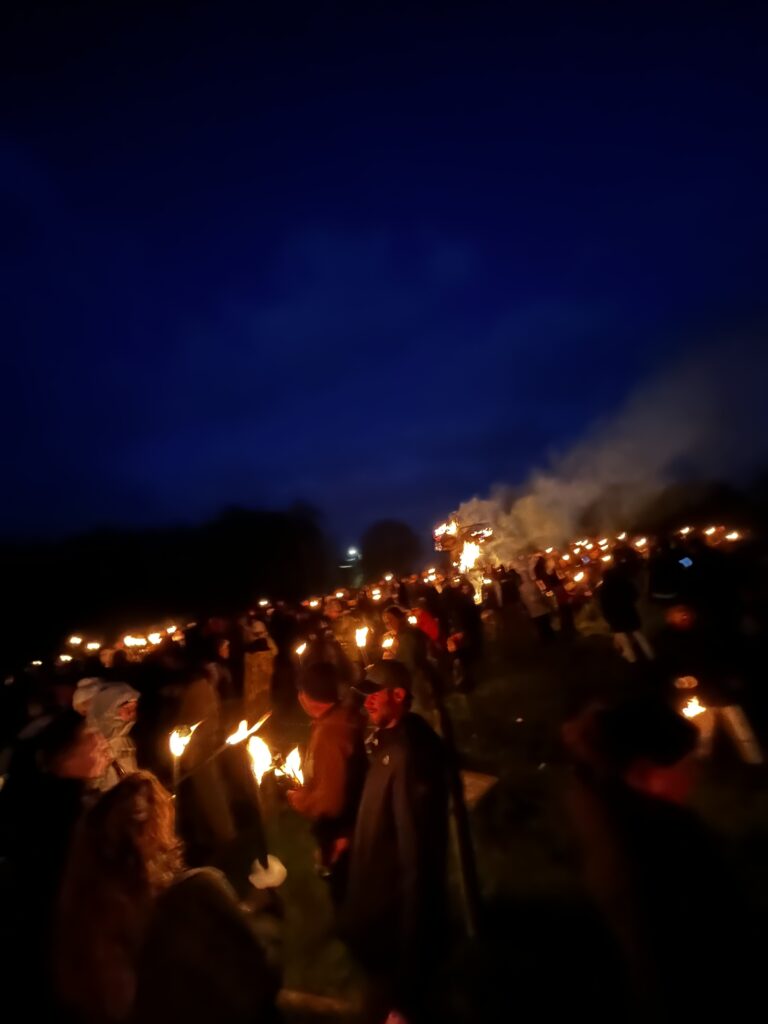
You can walk with that same intent today. Based upon the attested umgang and Dutch ommegang, we can envision a modern ymbgang ritual to coin an Anglo-Saxon equivalent—a circumambulation or ritualized walk in a circuit.
Whether around your home, a sacred grove, a community space, or a piece of land under your care, the act of walking the bounds in reverence is a real and historically grounded practice, which survived into Christian times in customs such as “beating the bounds” in England. It need not be scripted, but it should be conscious.
Suggestions for modern use:
- Walk sunwise (clockwise), ideally in silence or with purposeful speech.
- Perform three circuits, as in Æcerbot, or more if desired.
- Carry a token: a sheaf of grain, a carved staff, a stone for each round.
- Speak a line with each pass:“Erce, eorþan modor.”“Frith be on this land.”“May my path be right.”
- You may pour a drink, offer bread, or scatter seed at the close.
The land receives what is given in respect.
This is not borrowed mysticism—it is a Heathen act, drawn from our own ancestral materials. Walking in bigang is walking with purpose, with memory, and with presence. It is not spectacle. It is a way to mark your steps in the weave.
Conclusion: begin with the path under your feet
You don’t need a temple to live well. You don’t need a high seat to show reverence. You don’t need permission to begin.
Bigang is not a single act. It is the rhythm of your days. The tone of your words. The care you give to your house, your land, your name. It is how you live when the altar is cold and the hall is empty.
And if you fall short—walk again. That is the way.