 Written by
 Throwing out the Baby with the Bathwater
Among modern pagans and Heathens, there is a tendency in some circles to recoil from anything that looks “too New Age.” This instinct is often driven by a desire for historical seriousness and to distinguish modern practice from pop-spiritual commercialism. One casualty of this reaction is the widespread discomfort some express toward the idea of crystals, stones, or gems being used in sacred ways. People will pour beer on a sacred hearg, or dedicate jewelry at a shrine—but suggest that amethyst has some kind of spiritual virtue, and suddenly one is accused of importing nonsense. This distinction, however, is based on a misunderstanding.
To put it plainly: the belief that stones and crystals possess spiritual virtues is not a modern invention. It is not an alien graft onto European tradition. And it is certainly not the result of 1970s metaphysical bookstores. In fact, it is one of the most deeply rooted assumptions in both the Germanic and broader European worldview. If anything, the suspicion of such ideas is the innovation.1https://www.livescience.com/crystals-neolithic-ceremonial-site-uk
Lapidaries—texts that describe the properties of stones—were widespread in medieval Europe. While many were written by Christian scholars, their content is overwhelmingly derived from classical sources like Pliny the Elder, Theophrastus, and Damigeron.2Pseudo-Apollonius (Damigeron). Lapidary. In The Magical Lore of Precious Stones, edited by J. G. Hargrave, 1929. Reprint, New York: Weiser Books, 2000. Isidore of Seville’s Etymologiae, a foundational text for early medieval learning, includes a section on stones in which he lists their symbolic and healing virtues. The 11th-century bishop Marbod of Rennes.3Marbod of Rennes. Liber Lapidum. In The Natural History of Precious Stones and Gems, translated by C. W. King. London: Bell & Daldy, 1865. composed a lapidary poem cataloging dozens of stones and their effects. Amethyst, he wrote, prevents drunkenness. Sapphire calms tempests and the passions. Jet drives off serpents and demons.
The Anglo-Saxon scholar Bede is known to have composed a lapidary, though the text is now lost. That it existed at all confirms how deeply integrated this tradition was into early English Christian learning. Bede’s surviving De Natura Rerum already demonstrates his interest in cosmology, natural philosophy, and the inherited wisdom of the classical world. His lapidary would have been an extension of that same worldview.4Bede. De Natura Rerum. In Opera Bedae Venerabilis, edited by Charles W. Jones. Turnhout: Brepols, 1967.
It must be said plainly: the belief that stones possess innate spiritual or healing powers finds no basis in the canonical Scriptures of Christianity. The Bible warns repeatedly against enchantment, divination, and the attribution of supernatural force to created things. In Deuteronomy, the practice of using omens or charms is explicitly condemned; in Ezekiel, women are chastised for sewing magic bands and veils to ensnare souls. Nowhere in the Gospels or Epistles is there a suggestion that amethyst sobers the drunk or that coral calms the seas.
While gems do appear in Scripture—the twelve stones in the high priest’s breastplate, or the jeweled foundations of the New Jerusalem in Revelation—these are symbolic, not medicinal. Their significance lies in representation, not in any claim to affect the body or soul through inherent power.
The idea that stones carry such virtues comes instead from pre-Christian traditions, most directly the classical pagan world. Writers like Theophrastus and Pliny the Elder composed detailed catalogues of stones and their supposed properties. These texts describe stones that could protect against poison, improve memory, strengthen the heart, or calm the mind. These beliefs had nothing to do with Yahweh or the teachings of Christ; they were the inheritance of Greco-Roman natural philosophy, mingled with Egyptian, Babylonian, and Hellenistic magical traditions.5Theophrastus. On Stones. Translated by E. R. Caley and J. C. Richards. Columbus: Ohio State University Press, 1956. 6Pliny the Elder. Natural History. Translated by H. Rackham et al. Loeb Classical Library. Cambridge, MA: Harvard University Press, 1938–1963.
In the late antique and early medieval period, these ideas were preserved and reinterpreted by Christian scholars—not because they were taught in Scripture, but because they offered a symbolic and functional framework that could be harmonized with the new faith. Isidore of Seville, Bede, and Marbod of Rennes all compiled lapidaries describing the virtues of stones, and while they often invoked the order of creation to justify such powers, their sources were pagan through and through.
Lapidary Practices in an Ingwine Context
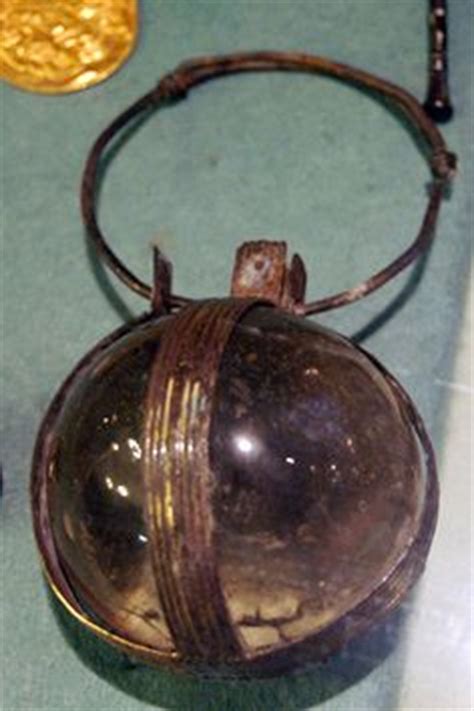
There is also a Germanic strand to this story that reinforces, rather than contradicts, what we find in the classical tradition. Archaeological evidence from Anglo-Saxon and Continental graves reveals the deliberate inclusion of stones—amber, jet, rock crystal—placed with care upon the body. These were not random ornaments but amulets, invested with significance. Scholars such as Audrey Meaney have demonstrated that these items had curative and protective functions, reflecting a native animism in which objects possessed mægen — force, might, or spiritual potency. This was not Christian doctrine, but the survival of indigenous belief.7“Lapidary Traditions in Anglo-Saxon England: Part II: Bede’s Explanatio Apocalypsis and Related Works.” Anglo-Saxon England 35 (2006): 35–75.
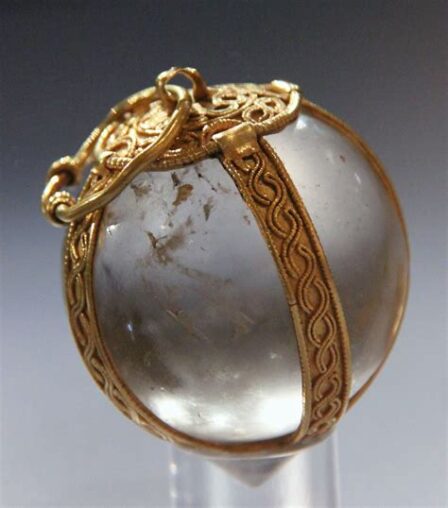
Anglo-Saxon archaeological sites are replete with examples of sacred or significant stones. High-status women are often buried with crystal spheres, amber beads, and garnet-inlaid jewelry. These items were not random grave goods. Scholars like Audrey Meaney and Gale Owen-Crocker have shown that such objects had curative, protective, or apotropaic functions.8Meaney, Audrey L. Anglo-Saxon Amulets and Curing Stones. BAR British Series 96. Oxford: British Archaeological Reports, 1981. 9Owen-Crocker, Gale R. Dress in Anglo-Saxon England. Rev. ed. Manchester: Manchester University Press, 2004. They were placed on or near the body deliberately. Amber and jet were associated with healing and protection. Rock crystal—clear and luminous—was likely linked with purity, sight, or divinatory power.
These practices were not limited to the British Isles. Similar use of stones is evident across Germanic and Celtic Europe. The Vendel graves in Sweden contain rock crystal and garnet. Merovingian burials include amethyst and carnelian. The idea that stones had power was not decorative fancy—it was spiritual technology.
Thus, to understand the presence of sacred stones in the early medieval world is not to see Christianity spreading its influence into paganism, but rather pagan cosmology impressing itself into Christian practice. It is not the Christianization of the Germanic peoples, but the Germanicization of Christianity. The Church did not teach that amethyst prevents drunkenness, or that sapphire brings divine favor. But these ideas were already deeply rooted in the cultural soil of Europe, and the Church, rather than uproot them, simply allowed them to grow beneath the canopy of orthodoxy.
Conclusion
To recap my position: the sacredness of stones, their attributed powers, and their use as vessels of spiritual force are not New Age inventions. Nor are they fruits of apostolic teaching. They are part of a pre-Christian metaphysics—classical, Germanic, Egyptian—that never truly disappeared, only took on new robes. And for those of us walking the old paths, this continuity is not something to reject, but something to reclaim. While our rationale for this sort of practice may differ from the New Age guru’s, the fact remains that the attraction to crystals, minerals and gems for both aesthetic and metaphysical reasons, and the belief that such may have a salubrious or apotropaic effect when worn or carried, is not a recent innovation, and is completely in keeping with the Fyrnsida.


 Written by