 Written by
 By H.E.
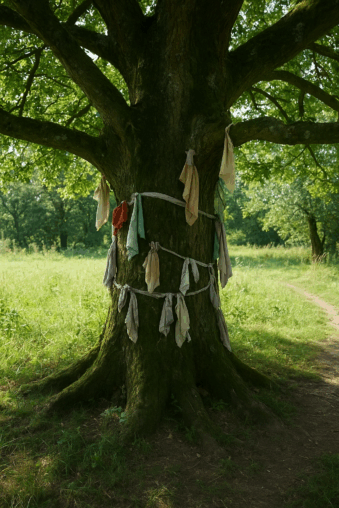
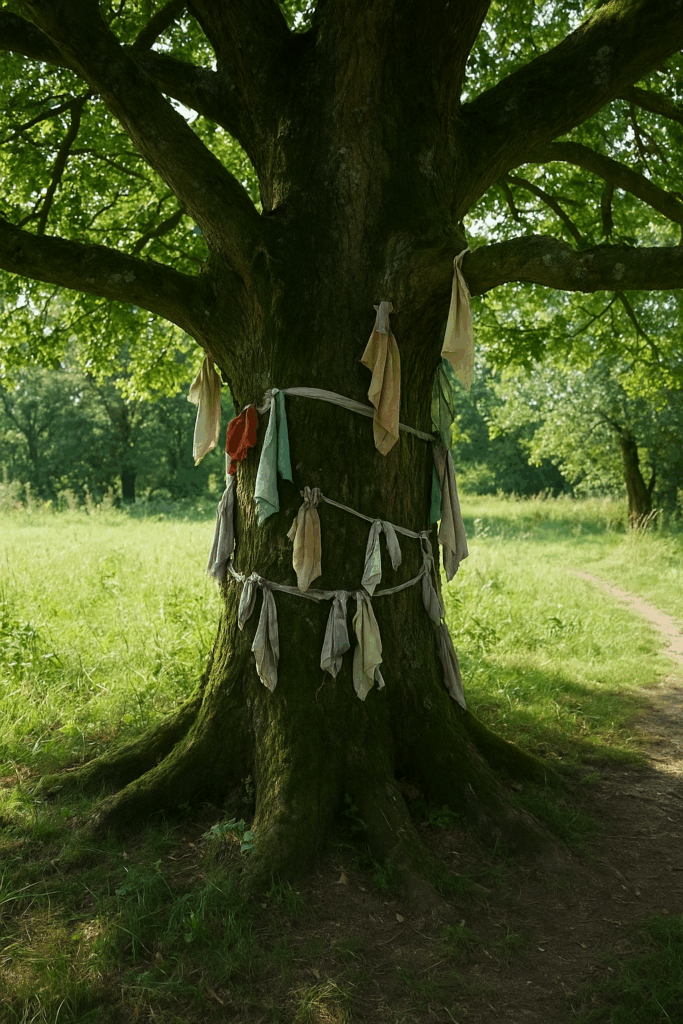
All over the world, people have tied scraps of fabric, handkerchiefs, or even entire pieces of clothing to trees in the hope of healing. These so-called fever trees—sometimes called rag trees—were places where illnesses, both physical and spiritual, could be “left behind.” By hanging a cloth on the tree, the prayer for recovery was thought to be transmitted into the branches, with the tree acting as a messenger between earth and sky.
The tree’s natural structure made it an ideal conduit. Rooted deeply in the ground yet reaching toward the heavens, it symbolized a bridge between humans and the divine. This practice was widespread in Europe, where both Celts and Germanic peoples held sacred ceremonies around trees. The oak tree was often associated with masculine energy, while the linden tree represented feminine energy. In the Netherlands, linden trees were particularly revered. Many village lindens were pruned in three tiers: the top layer symbolized the world of the gods, the middle layer represented the earth, and the lowest tier corresponded to the underworld.
In the Netherlands and Belgium, such trees can still be traced, in places like Herchies (BE), Breda (NL), and Bergharen (NL)… even as far as the Alps.
The piece of cloth was first placed by the sick person overnight. Afterwards, it was hung on the tree in the hope that the tree would take over the fever. With Christianization, these trees often received a Christian consecration—dedicated to the Virgin Mary, for example—or were given another name. If this did not help, the trees were often removed, roots and all, sometimes replaced by a small chapel.
In some regions, people used a variation called nail trees. A blacksmith would forge a special iron nail for the ritual, which was hammered into the bark to represent the illness or affliction. Once the bark had grown over it, the sickness was believed to be gone. The nail carried the prayer or intention of the patient, much like the cloths. The nails were specially made by the blacksmith, who also imbued them with the intention of the ritual. There is little known about the use of iron in Europe outside of its frequent appearance in votive offerings. An example of this is the nail trees of Yde (Drenthe, Netherlands).
When I discovered this nearly forgotten tradition, I felt a deep resonance within me. The power of prayer, increasingly acknowledged even by scientists, opens a gateway to connection with the living world around us. This prayer can become even stronger when paired with a ritual that focuses our intention and strengthens our bond with the energies that surround us.
Nailing objects into trees brings harm to these life forces, something we seek to avoid through an animistic and respectful way of life. The ritual with the fabric cloths, however, invites a gentle, life-renewing act: it can breathe new fire into old connections, a current of attention and reverence flowing once more in harmony with nature.
Sources:
- Wikipedia: Koortsboom
https://nl.wikipedia.org/wiki/Koortsboom
- Goden en Sjamanen in Noordwest-Europa, Linda Wormhoudt

 Written by