 Written by
 20 september 2025. Osric and Leofrun had landed in the Low Countries just 5 days before. Their arrival came along with the change of weather; a North Sea storm swerved in and swept away the summer weather. In its wake dark grey clouds descended over the Ingvaeonic shores of Belgium and Netherlands. Just two days before the astronomical fall-equinox, heathens for Netherlands group Swesaz and Flemish group Traditie, gathered at Colijnsplaat in Zeeland, Netherlands. Among them an American family from Colorado, the driving force behind Ingwine.
It was an honor when Lianne from Swesaz asked me to author an introduction about Nehalennia and to read it at the start of the event. Before describing the ritual, you can read the translation of my introduction.
Good afternoon everyone! Some of you know me as Jorre, from Traditie and Belgian Heathen Heritage and the Ingwine Society, whose founder, Rob Holman, and his family are also here, all the way from Colorado.
It’s an honor to have been asked to speak here, and I thank you for that opportunity.
Now let’s talk about Nehalennia. Hopefully, everyone will still be awake when I’m done...
Nehalennia, a goddess shrouded in mystery. According to a Germanic etymological interpretation, her name could be translated as “She who disappears in the mist.”
And that a great deal of mist surrounds her figure is undeniable. And so it should be, for nothing inspires more thought, searching, and awe than the things we cannot comprehend. So I won’t try to dispel the fog; no, if I can, I’ll add a layer of mystique.
Nehalennia is a name that fuels various theories. I won’t go through them all, but I wanted to include this one by Gijsseling and Bogaers.
At that time, a dialect was spoken in our Flemish regions, which was probably a mix of Germanic and Celtic and can best be described as Belgian. The Menapii, a Belgian coastal tribe, lived in Zeeland at that time. Their language is said to have preserved many older Indo-European names and terms. They were known for their salt mining, breeding and preparing wild boar, their naval skills, and even then, as a precursor to the later Flemish textile industry, they were known for their high-quality textiles.
The name Nehalennia most likely derives partly from their language and is a derivation of the Indo-European nei-, which roughly means “to lead.” In Zeeland, the goddess acts as patroness of merchants sailing the North Sea. She is sometimes depicted with a hand on the rudder or standing on a bow. Her name can therefore be interpreted here as “guide, helmswoman,” and thus she is the one who guides the ship safely across the sea.
-Do Ut Des-
Shortly and powerfully described in Latin and uniquely recognizable in the cult surrounding Nehalennia:
-I Give, So That You Give-
Nehalennia received gifts in exchange for a safe return.
The sand and mud of the Zeeland coast preserved for us the relics that would first speak to us again about our beloved goddess in the 17th century. These were found near Domburg when a storm rearranged the dunes. And later, by chance, a fisherman in the early 1970s near Colijnsplaat made the first discovery of hundreds of altar stones and votive stones. They surfaced—literally! — The sea takes and the sea gives. In this case, a wealth of information.
On these stones, we read inscriptions from sailors and merchants thanking Nehalennia for safe voyages. It is striking that the votives in Colijnsplaat are all directly connected to the trading mission.
The votives from Domsburg seem more personal in nature and were not limited to Nehalennia. Votives for other gods such as Jupiter, Neptune, and Hercules were also found there.
Some of the votives found are said to have been made in Tongeren.
Finds in Saxon regions of England even give rise to a theory that she was also part of the pagan religious world there.
A major Roman city, known as Ganuenta, was located in the Colijnsplaat region at the time. The city was a crucial stopover for trade with London.
Luxury products that were popular both in and outside the Roman world, such as wine, salt, and fish sauce, were traded through this port. Inland and seagoing vessels could be found here, including one that you can admire next to the temple today:
Now I’m probably going to do the name a disservice:
the “Caudicaria Navis”
was reconstructed by Ludo van Well, the temple’s key keeper and also an expert in the world of shipbuilding.
The ship was eminently suited for crossing the North Sea with goods, but it was also a very formidable opponent in naval battles. Roman ships were no match for this maneuverable and seemingly indestructible pride of the Menapes. That’s why I like to call it the Menapian Ship.
There’s no doubt that the depictions of Nehalennia on a ship are of a Menapian ship, because in the words of Dimp Nelemans (who recently left to join the ancestors), and also the title of her book: “What is Nehalennia without a ship?”
The presence of the important port city as a gateway to the British Isles, the inscriptions on the votive offerings, and the importance of this route, also attested to by numerous other sources, suggest that the temple at Colijnsplaat was part of a larger entity.
Romans often used local deities to influence the population and involve them in their plans. A temple for Nehalennia with its accompanyingThe cult in this Roman port city must certainly have made an impression on the local population, who were indispensable to the activity as experts on land and water, as skippers, salt producers, and guards.
It appears that the temple in Colijnsplaat was of strategic importance to Rome in maintaining the trade route and showing goodwill to traders and skippers.
On the votive stones, we see the same symbols repeatedly:
**The dog: usually a calm, sedentary four-legged animal. It is often seen as a symbol of loyalty and vigilance, but also as a guide to the underworld.
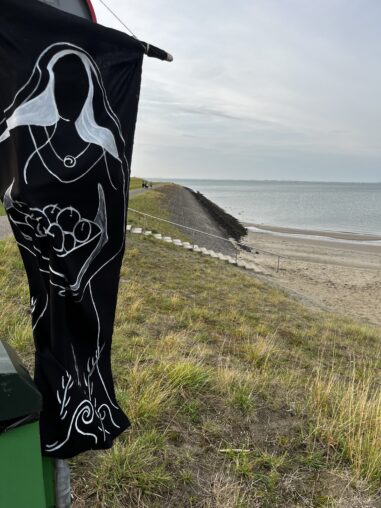
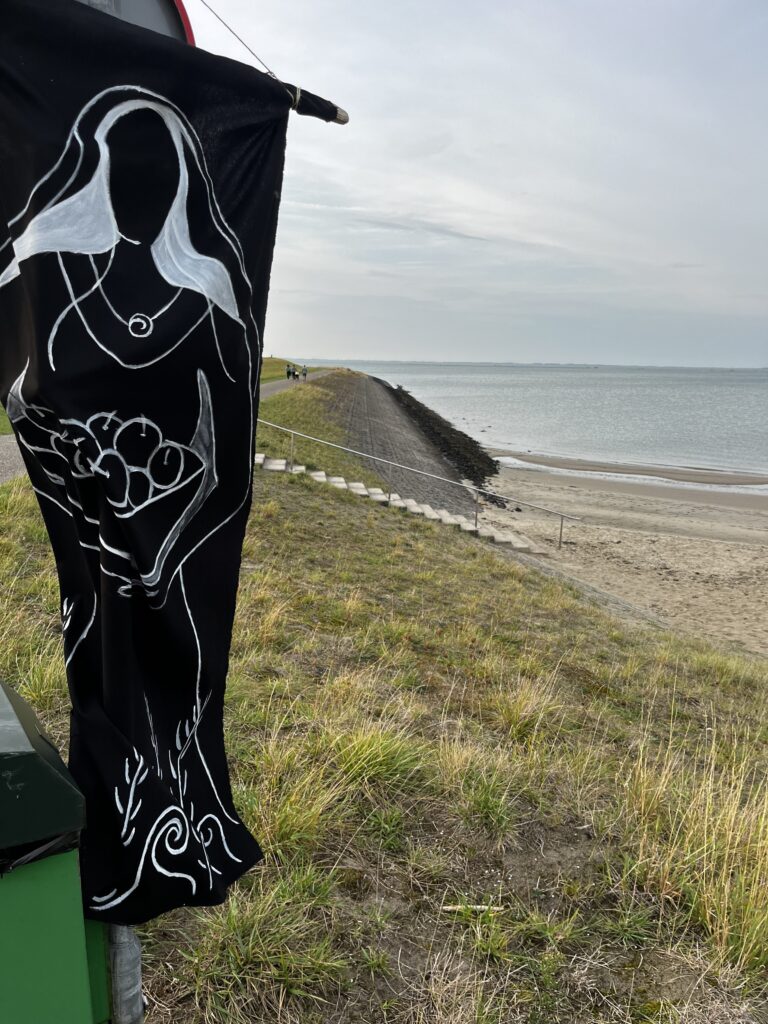
**The cornucopia, the overflowing basket: filled with fruit, bread, or grapes. A clear sign that Nehalennia was not only concerned with shipping, but also with prosperity.
**The ship or the ship’s prow: Nehalennia as helmswoman of the sea. A goddess with a knack for navigation
**The shell-shaped canopy under which she is sometimes depicted: this points to her divine status and is typical of Matrons or mother goddesses.
**Ears of corn, flowers, or a scepter: symbols of fertility, agriculture, and power.
**.. and not to forget the Zeeland cloak!
Who was she, exactly? That remains a bit of a mystery. Some think that Nehalennia has her roots in the tradition of the **mother goddesses**: protectors of fertility, abundance, and well-being. Think of the primal mother figures found throughout Europe, often with round shapes, ears of corn, or… a full horn of plenty.
Nehalennia has several intertwined qualities. She is clearly a guardian goddess who can offer protection on journeys, but she is also a fertility goddess and a goddess bound to death. Judith Schuyf notes that we find the same qualities in Hludana, also known as Lady Holle.
Nehalennia is often associated with the Matrons, a group of three goddesses worshipped primarily in Germania. They, too, symbolized fertility, protection, and abundance. It’s quite possible that Nehalennia was a local, maritime variant. There’s also a votive stone where she’s flanked by two female figures; more than likely, Nehalennia is depicted three times.
Thinking of triads also brings to mind the Fates.
Weaving fate, determining life and death, is their responsibility. Does this mean Nehalennia had a close relationship with the Fates, or was she simply a Fates?
Later, we see the Matron cult fade away, and from the Anglo-Saxon world and later also Viking culture, the Modra, the exalted mothers, and the Disir emerge. These demigods can even be linked to the Matrons in name. They also control fate, have their own feast day to honor them with sacrifices, and are all bringers of fertility, happiness, wealth, and protectors of the family and home.
Christians, too, later had triune saints and similar functions in their faith. If this line of reasoning can be extended, it proves that the importance of these holy mothers must have been immense, so great that it continued to dominate culture across time and space.
If we look at traces in present-day Flanders**, we must be honest right away: hard archaeological evidence for a Nehalennia sanctuary in Flanders is still lacking. The major finds come from Zeeland. BUT, present-day Flanders lay on the same trade routes and belonged to the same tribe of the Menapes.
The Scheldt delta connected Flanders, Zeeland, and the Rhineland.
Wouldn’t it be plausible that a cult of such importance was also known to the rest of the Menape tribe? Could Nehalennia have left traces in Lissewege?
There we have the veneration of the White Mary. According to Johan Ballegeer, yes.
A statue of Mary is said to have surfaced three times in the water. People saw this as a divine sign.
This led to the construction of a church. Since then, there has been an annual procession in which the sacred statue of the Virgin was carried. Unfortunately, the statue perished in a fire in the 16th century.
An old folk legend speaks of a shrine or altar dedicated to a female deity. Some versions also mention a “white lady” or a “sea goddess” who offered protection to fishermen and travelers. Some local historians suggest that this was a pre-Christian cult that later merged with Christian symbolism.
Interestingly, Lissewege is strategically located between Bruges and the coast, with access to waterways that were likely navigable in Roman times. This would make it a logical location for the shrine. The veneration of Mary was widespread on the Flemish coast in the fishing communities of De Panne and Oostduinkerke, which are well known for it.
It is perhaps no coincidence that the statue of Mary in Lissewege is painted gold when the sun shines on the horizon.When the image falls, a bright shimmer appears. The White Lady also reminds us a bit of the White Women and the White Whites; the elves are said to be bright and luminous.
After all this, we are left with much food for thought. How old is Nehalennia, and where was she worshipped besides Zeeland? Was she a goddess of fate, a guardian goddess, did she also bring full fishing nets… a little bit of everything?
As people of our time, we have the habit of pigeonholing and labeling everything. Perhaps we sometimes take this a bit too far. Perhaps our gods are defiant. And I think it’s sometimes better not to know everything and to leave some room for the twilight, some room for the mysterious and the incomprehensible.
May Nehalennia bless you all today, thank you!
The Ritual:
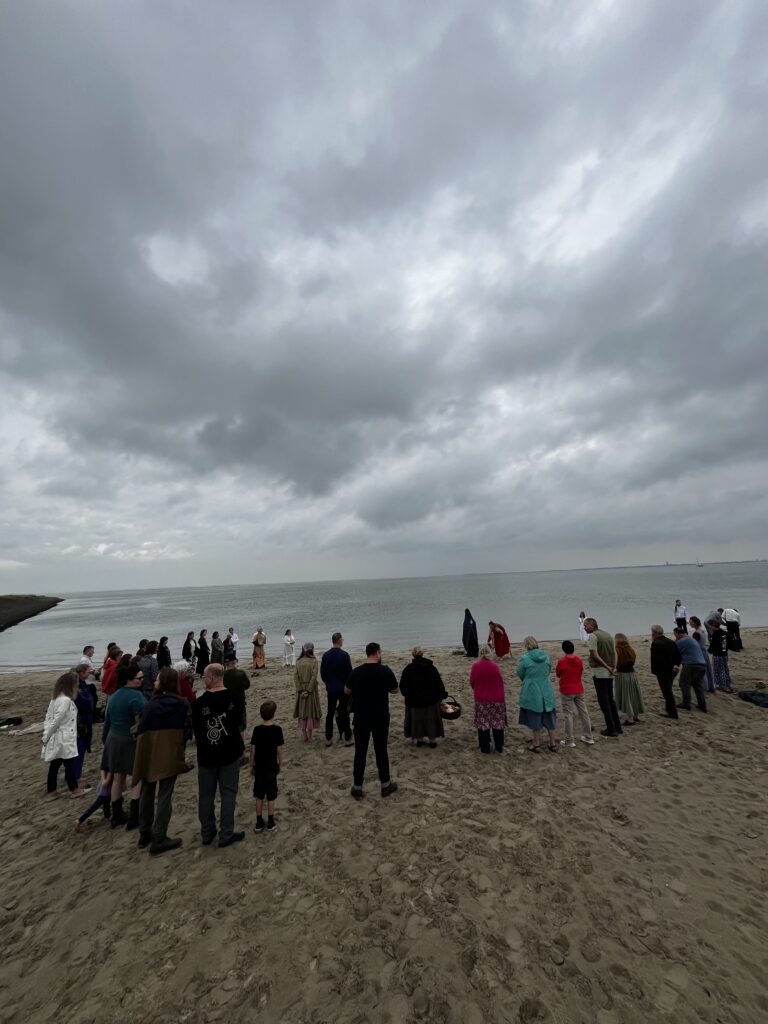
We had gathered under the rainy sky by the shore of Colijnsplaat on a stretch of grass overlooking the temple and sea. Down the seawall a little way into the water up to the knees, stood a hooded figure in a grey-blue cloak with its back towards us. Someone whispered that the goddess was among us and waiting.
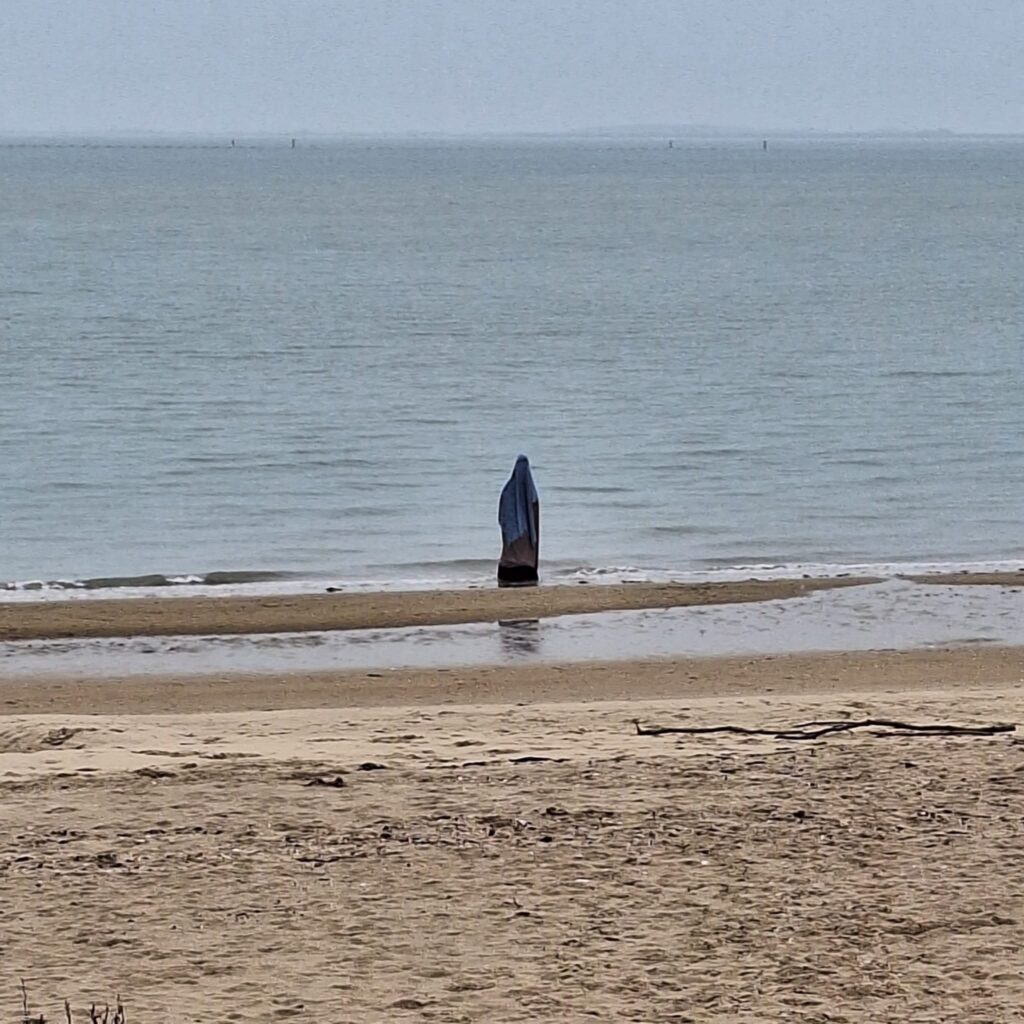
A call came out by the priestess, dozens of people, including children, gathered by the stone steps that lead us down to the beach. A couple of men dressed in white shirts escorted us. The priestess, dressed in a red and white cloak took charge and had no issue asserting authority for her eyes seemed to read every mind. We stood around the hooded figure in a half circle while two ladies dressed in white gowns came behind us with willow baskets, filled with bread and apples. The priestess signaled the men, who stepped into the water and appeared to negotiate the mysterious figure into joining us. We stood all in silence as the hooded entity turned towards us. The tall and imposing figure could did however not reveal its face. The hood kept it darkened and mysterious. Under leadership of the priestess Nehalennia was welcomed. Several offerings were made, bread, apples and a roaring fire were gifted. As she consumed the offerings, so did we all, and together we processed the offering, thus filling our soul and ordering the chaos.
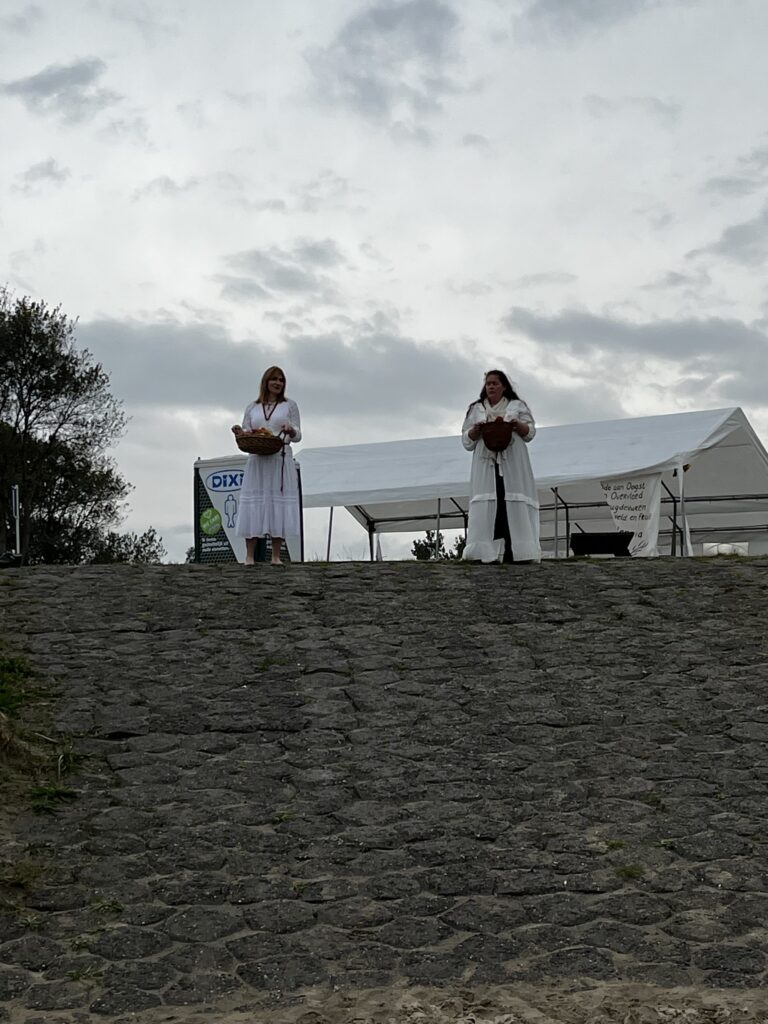
The men now escorted the goddess up the stone steps to the meadow where the gathering was held. We all followed in silence while eating the blessed apples. In the meadow we would spend our time creating artwork gifts, conducting meditation and deepening our knowledge of lore and symbology that shroud the goddess of the North Sea. The goddess now joined us on the meadow where she overlooked our activities.
The Ingwine members went up to the temple for a personal moment honoring the temple and the goddess with gifts and messages.
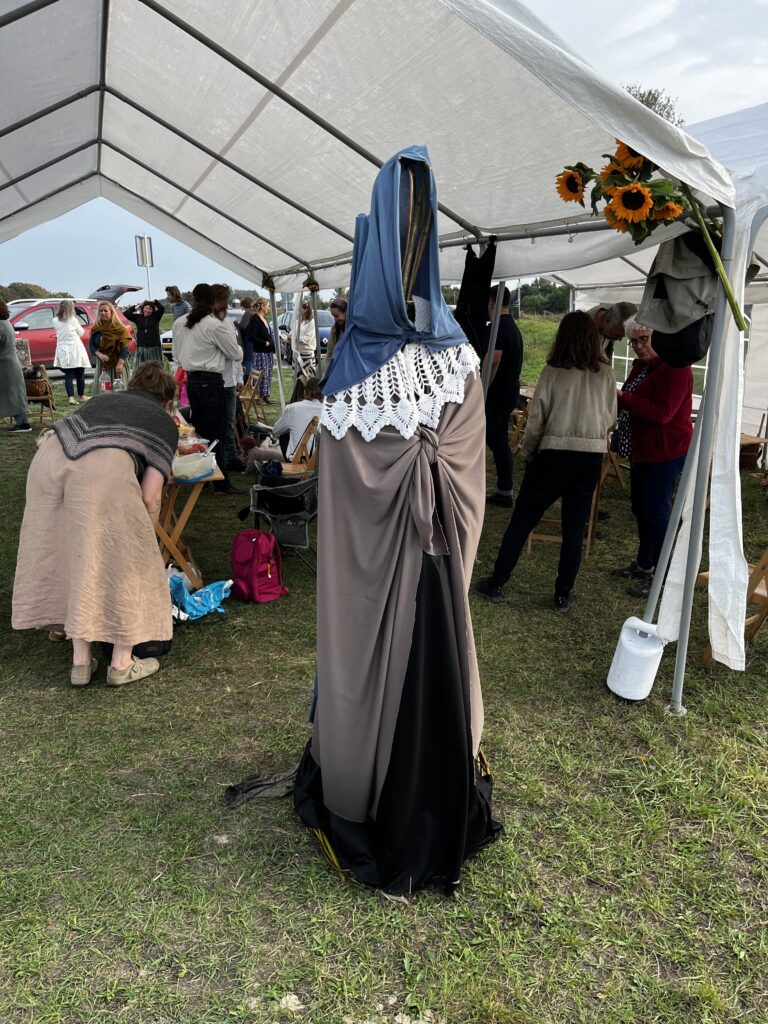
A feast followed under the grey clouds, an abundance of food was laid out on the tables. Cakes, bread, meat, cheese, dishes, beers, fruit, … There was enough to feed a tribe. Some of the women sang songs and played music on bagpipes and flutes.
As the sun was getting ready to descend under the horizon, the priestess once again called to the people to join. Nehalennia was ready for the final part of the Ommegang. The men in white shirts once again cordoned around her and they moved towards the temple down the seawall. We all walked in a long line behind her and one of the white shirted men came up with bottles filled with gold liquid and a huge horn. Some of us carried flowers that had adorned the meadow and tables. Nehalennia went around her temple following the path of the sun before settling on the stairs overlooking the people that now stood to attention at the foot of the temple. We thanked her for her presence and the abundance and protection she had given us. We thanked her for overseeing the travels of the dead.
Just like the sun is retreating away from Midgard to make room for the cold and dark and the returning dead, Nehalennia turned away from us and retreated into her temple. Under the leadership of the priestess the white shirts started filling the horn with mead and every one there was offered the sacred drink while speaking words of praise to the goddess.
“Heil, Nehalennia!”
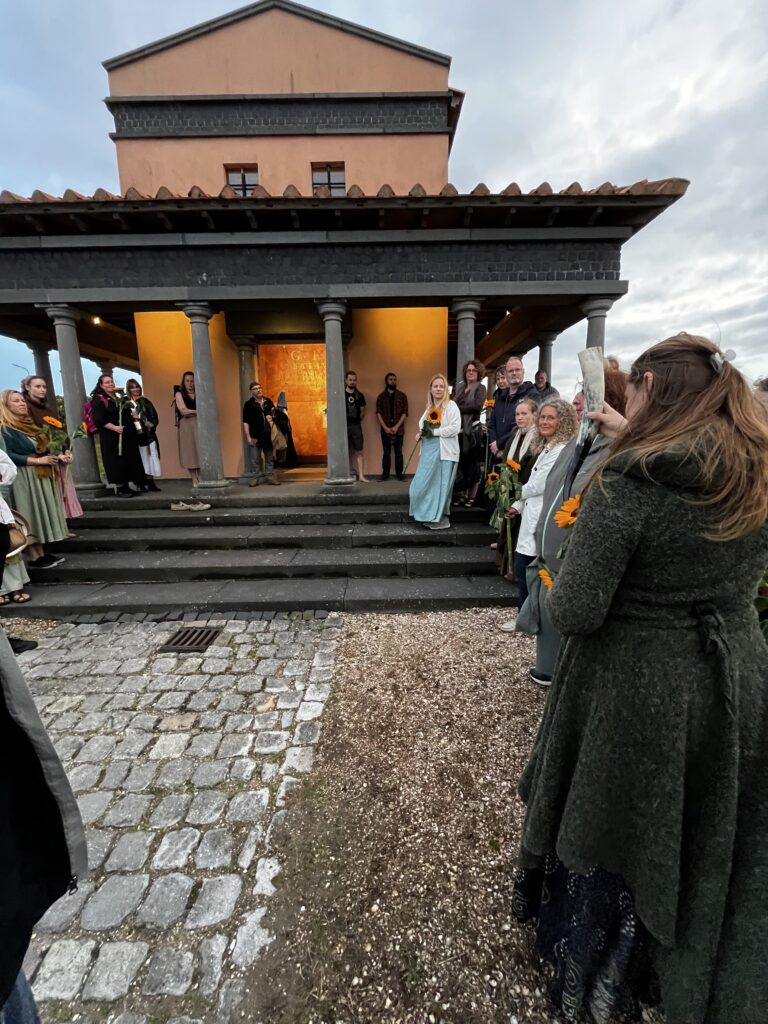
The sun was now almost departed from the low land, sea and sky glowing a dark orange, dark shadows growing, corners and trees becoming patches of lurking darkness. The temple had been filled throughout the day, with offerings of every kind. Votives in the form of rocks, seashells, carved woodpiles, bottles of mead, apples, artwork and coins of money laid on the statue and table.
Outside the people melted away to make room for the entities of night. The ones who lingered talking kept a respectful distance of the temple stones. Nehalennia was now home for the winter and she was overseeing her offerings, we would not disturb her.
After saying my goodbyes to new and old friends, I drove through dark village streets and between silent meadows. Cosy living rooms were lit with warm lights in farmhouses, people were hunkering down for the night. Others, teenagers, were out and about on bicycles heading for a few beers in the village bar. The country life goes on, like it always has, in the close proximity of the goddess sacred grounds.
 Written by
 Written by