 Written by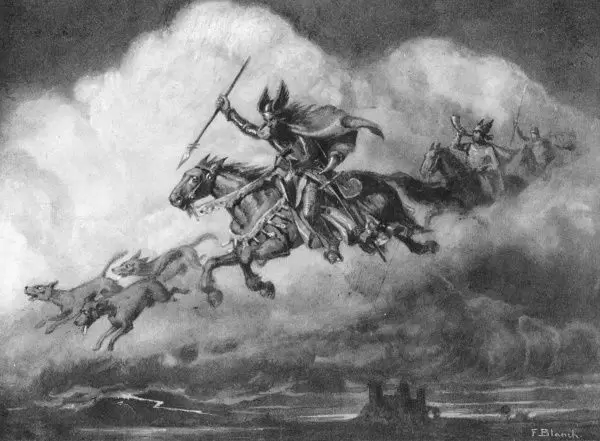
(Written by Jorre, research support by Erwin Horckmans of Traditie and Axnot from Swesaz)
Sinter Marten
A number of cultural midwinter traditions in Belgium, appearing Catholic at first glance, hold deep germanic roots in reality. From Carnival to Sinterklaas, from Kerst to Sint Maarten and Sinte Greef and others like Bommels.
All of these traditions have a few central elements around which the tradition is build and evolved which mostly are directly connected to the Wild Hunt. We see the same elements paralleling in traditions that evolved and grew separately in different parts of the country (from present day Northern France, formerly Flanders to all other dutch speaking area’s and links to German area’s) but even across the rest of Europe.
- A masked procession of one or more masked figures, locally known in Flemish as an ‘Ommegang’
- The Ommegang will visit homes or villages at which point the central figure takes charge of events and the people, in some places there is even a symbolic handing over of the key of the town from mayor to ceremonial leader of the Ommegang.
- The procession’s activities relates to people’s behavior and can be rewarding or punishing and in the case of Carnival it is ridiculing the community leadership (punishing), in the cases of Sinterklaas and his variants it is both punishing and rewarding of the community members
- The Ommegang members hold magical or divine powers such as supernatural traveling and all seeing and knowing capabilities or they operate with impunity for the duration of the Ommegang because of the sacred task they must perform. Its members also shapeshift using a veil of paint or masks.
- There is a giftcycle involved: food, services and other gifts may be offered and received during the Ommegang. In most, the Ommegang members trow with sweets and cookies
- Timing is always during the winter months
- In some there is a horse involved, always a White-Grey, (‘Schimmel’), that acts as psychopomp
- Horrendous noise (“Wild Geraas”): the making of horrible loud noises using the voice or instruments of all sorts, the noise is supposed to scare the harmful spirits away
They all relate undoubtedly to the old Wodan cult and his army of dead known as the Wild Hunt, which in turn is linked to initiation and fertility rituals revolving the warrior bands, coming of age rituals and the passing of winter and bringing of fertility for the next season.
Sinter Marten, Sinte Mette, Sinter Merten or Sint Maarten … some of the names for the soldier Martinus of Tours. This soldier decided to become a Christian after a dream, and donated half of his cloak to a poor naked person by cutting it in half with his sword. First mention in the 5th century by Perpetuus of Tours. When we scratch the surface of Sint Maarten, we find a very pagan symbolic figure.
In all of Europe, both Celtic and Germanic cultures, there were celebrations held for the start of winter. The date of these celebrations changed form one area the another depending on the local seasons. The start of actual winter in Scandinavian area’s started much earlier in October, hence winter traditions start halfway or early in October. While Samhain for example starts end October, beginning of November. In both cultures, these events appear to focus on the dead who are given free access to our realm in this time. It is likely a continued Indo European tradition. It is assumed Sint Maarten absorbed the local South-West Germanic traditions of start of winter, his holiday was set on 11 of November, which was certainly around the time the start of winter was observed in this area. It is no coincidence that we find the Christian holiday of Allerheiligen, All Saints on November the first.
At start of winter there was a pagan custom of slaughtering animals, having one last big feast with elaborate different ingredients of food before the winter diet began. The baked cakes and cookies in shapes of animals also relate to this, especially the pig, which was the traditional animal to slaughter at start of winter.
A number of pagan traditions can be recognized in his celebrations.
In Sweden on the isle of Runö where it goes under the name of Martinshesta (Martin’s stallion), these stallions are represented by masked men.
Again, this Ommegang leader rides a white grey (Schimmel) horse just like Greef and Sinterklaas. In some cases he is known to be carried on a chair or cart to go around the village in procession like old tribal leaders were transported during special events. But most usually the Ommegang is lead by Maarten on his horse, just like the Wild Hunt was headed by Wodan on Sleipnir. In Germany children would dress together to look like a big eight legged horse. They would hand out baked cookies, bread or cakes in the shape of a horse. As with other winter traditions, the white-grey horse, sacred in Germanic culture, appears central. The psychopomp of death is the vehicle of magical transportation for the leader of the Ommegang.
One of the most noticeable traditions on Sint Maarten was to ignite great bonfires at night. The church went through great effort to try and abolish these but they didn’t succeed, so great was this traditions with the people. It was also custom to place a lit candle by a window or door so that the dead could find the house. People would also carve out faces from beet and the Ommegang would carry the beet with a candle inside.
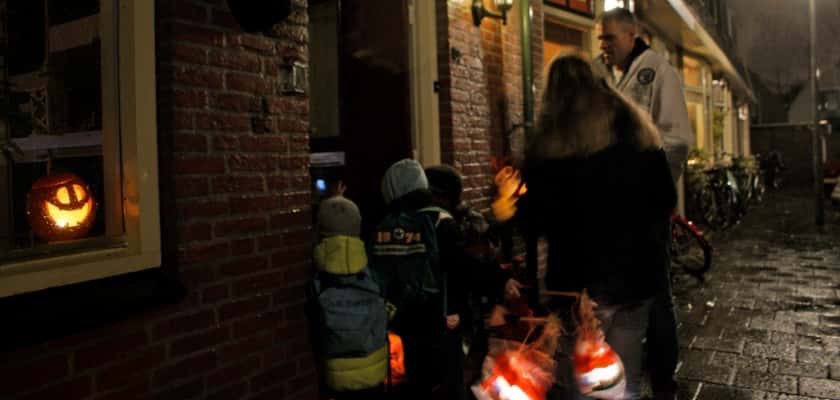
We find laws from the 16th to the 18th century regularly calling out not to ignite “Sinte Martensveur’ and also not to make a horrible racket using devices that produce horrendous sound, these proclamations were made so regularly by the church in such a way, that is obvious the church did not condone the practice.
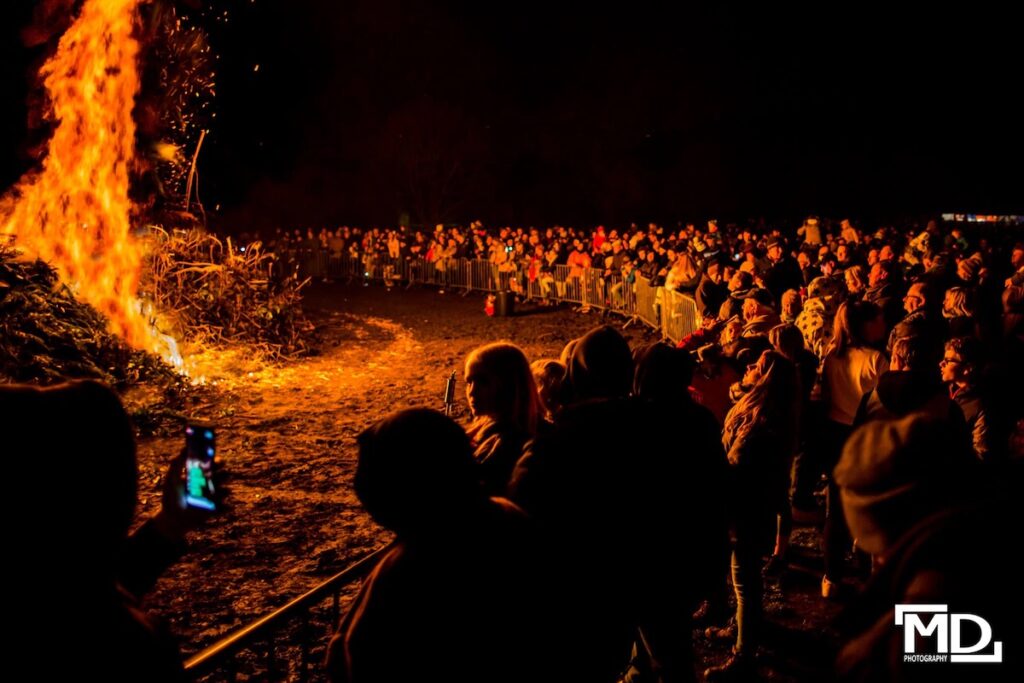
The burning of bonfires is a clear pagan element used during equinox celebrations but also in sacred ritual. The making of horrendous noise also turns up in other midwinter celebrations around Europe, and was a way to announce the coming of the dead: the Wild Hunt legends for example go hand in hand with the making of a terrible noice across the sky or in other cases a leader warning people with a sound or yelling of the coming of the hunt/dead so that they may be prepared with offerings, or in later Christian twist: so that they can hide and look away, for the hunt were demons who would carry off anyone they would meet, which meant death.
Just like in Sinterklaas and Greif tradition, speculaas, candy, cake, pepernoten are present elements. With Sint Maarten hot apples and pancakes were also a prominent element. People would disguise themselves with scary masks and go house by house. Depending on time and space, they may be asking for wood, to create the Sint Maarten’s fire, or they would ask for food. In some cases it was custom they would make a small fire in front of the residence door. The singing of songs during this Ommegang was common but many were lost. Whenever the party was refused by a house one of the customs was to sing these lines:
“Hoeg hôas, lieg hôas, er zit een gierige pin in hôas!”
= “Big house, little house, there is a cheapskate in this house”
Witch is again a punishment served by the Ommegang members who perform the sacred task of keeping the community in check.
In Germany, the Percht and Krampus traditions work the same way, only there Percht and Krampus have been demonized to more extreme ways by the church to make the custom unattractive and negative. But the lines that are song when a house refuses to open for them are nearly word for word the same, which is further proof of these traditions to have a common root.
Another interesting line that is sung with Sint Maarten:
“Kreupt al gaa in de schaa, leut wa appele en peire vleege, ge zult ons nie bedriege.”
= “Crawl into the chimney, ignite some apples and pears, you won’t deceive us”
It places the chimney in its central role again where the offering is made. It speaks of deception too, which may relate to the shapeshifting maskerade or the ability of the Ommegang leader to see and know everything.
Elements around Sint Maarten are clearly found from Hungary to Scandinavia, down to northern France, and Austria all mostly along the same lines.
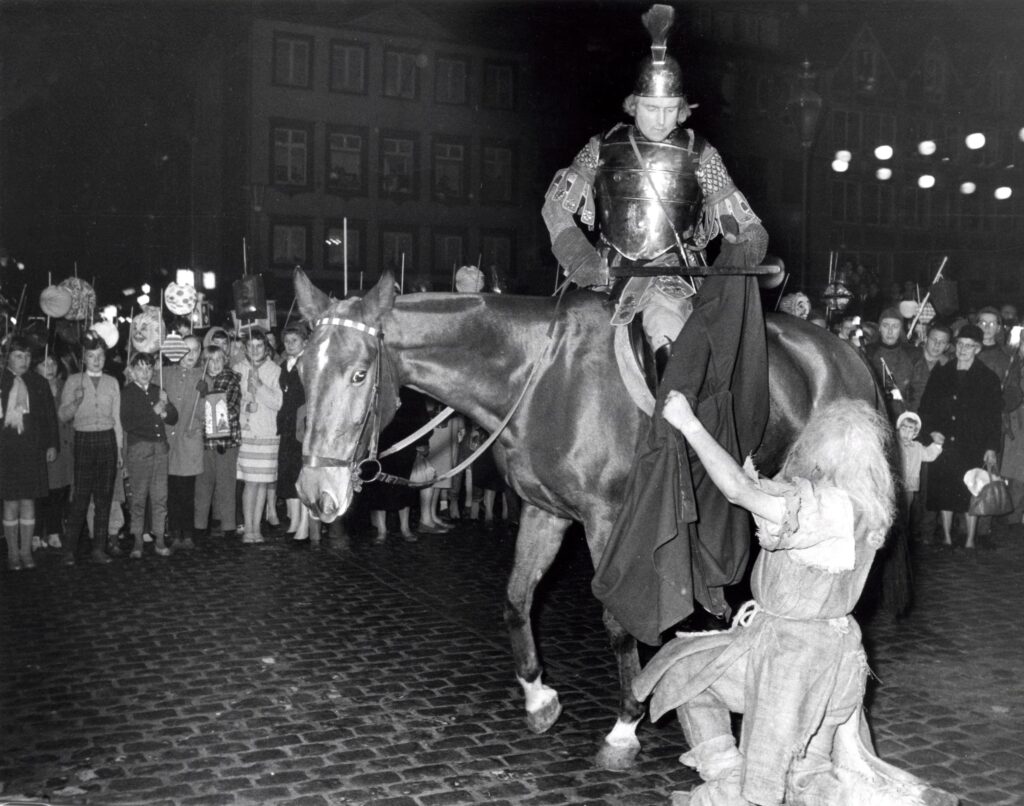
University project “THOMAS” of KU-Leuven confirms that Sint Maarten is the continued traditions of both Celtic and Germanic pagan customs incorporated into Christianity.
Sinter Klaas
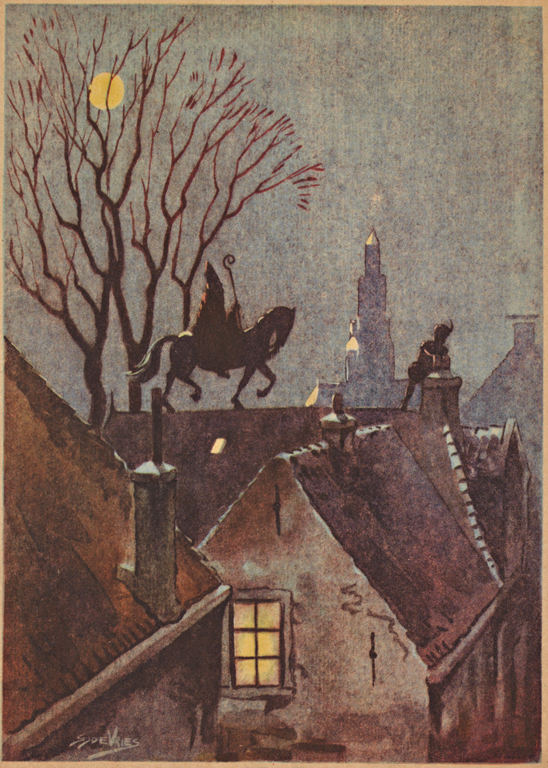
In the previous article of this series we discussed Sinter Marten, a figure still prominently celebrated in various regions of Belgium and also in neighboring countries. Now we move on to his cousin, a more famous saint who is not so much different. Like Sint Maarten he wears a red cape, rides a grey-white horse and visits the people using the hearth. He is Sinter Klaas, Sint Nicolaas, Sinterklaas, Nicolaas van Myra or in short, De Sint.
We rewind time back to the 3rd century to Myra, Byzantium, modern day Greece. This is where the historical figure, Nicolaas of Myra is living as a Bishop. In his life he was great in helping the poor and many legends go hand in hand with this. By the 6th century the memory of Nicolaas was great enough to have a church in Myra named after him. It is also around this time that the church is working hard on converting western Europe. The local nobles are quick is to convert because of the power and benefits of this new Christian ruling elite. But the common people who have little to gain and live in more remote places and do not speak latin, are harder to reach and refuse to abandon a number of old customs. The church introduces a number of saints which are meant to replace the different gods of the local heathens. One of them that shows up is Nicolaas of Myra. And it is at this point that we start to find sources that tell tales of magical events surrounding Sinterklaas. He becomes a patron saint of numerous things, patron of the sailors, of marriage, of children, of the poor, of prostitutes, prisoners, wine merchants, of seaports, shipbuilders, fishermen… A legend also tells of Sinterklaas subduing a storm. All these elements have some interesting connections to Wodan. It is assumed the date of Sinterklaas visit, on December 6 is based on the day of the death of Nicolaas of Myra.
One very consistent European tale that is found in the Frankish area of North France, Belgium, parts of Germany and Netherlands is this one:
One day three young men disappeared from the streets after they had gone out the house. No one knew what had become of them. But Sinterklaas, the all knowing, payed a visit to the butcher. In disguise. He asked for meat to roast so the butcher brought out a nice chunk. Sinter Klaas was not impressed, he said he preferred his meat much fresher, softer and salted. The butcher went to fetch meat from a sealed kettle with salt. Yet before he could open the lid, Sinterklaas came to his side revealed his identity and tapped the kettle with three fingers. Up jumped three children out of the kettle. For the butcher had killed them and stored them there, but now they revived.
Similar versions of this tale exist, sometimes the butcher is the warden of an inn. But consistently we find the sacred heathen number 3 and the kettle or keg and the magical reviving by three fingers of Sinterklaas. This keg turns up in old depictions of Sinterklaas. A parallel can be drawn here with coming of age initiations of our pre Christian traditions. The boy would be kidnapped from his place of living, then be ‘killed’ so that the boy would ‘die’ and later the man can be ‘born’. Three fingers form the shape of the Algiz rune, or Eolh, a rune believed to have the magical value of life and death and protection, also referred to as the man-rune. The keg is also a symbol we see turning up in Germanic and Celtic traditions in reference to death and rebirth and appears in depictions of Sinterklaas. The Gundestrup cauldron is probably the best known example alongside the kettle of the witch used to cook children… Putting a person in a keg for initiations is also a tradition that is found in several European countries. Later on we see the keg being replaced with a bag, and at some the punishing element makes room for only the rewarding element and instead of little boys, the bag is now filled with toys.Yet it remains part of the tradition to put bad children in the bag as a punishment.
Fast forward in time, one memorable day in my youth some 30 years ago.
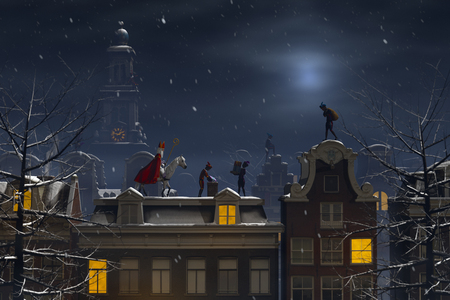
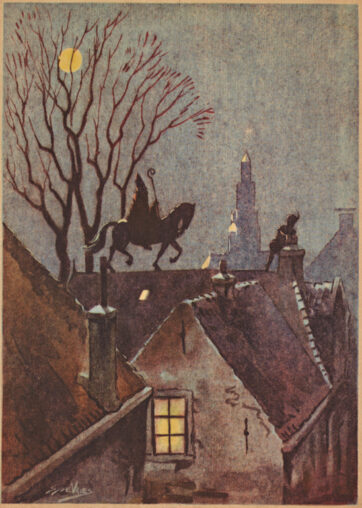
The evening is cold and dark, the drizzle of rain has started to freeze over and a menacing fog is descending over the village. Smoke from the many hearths is swirling above the rooftops, mixing with the fog. I m looking out the window, feeling the outside cold creeping through the glass. Peering out to try and spot Sinterklaas and his men moving across rooftops or coming down the cobbled street that leads to the old forest. The day is December 5, and I have just finished preparing my offerings to Sinterklaas, its only afternoon but the dark of night has already set in. My shoe is stuffed with a carrot, sugar, a marzipan pig and a few large glasses and some bottles of beer and milk. I made sure it was positioned by our hearth, because that was the way Sinterklaas would come and its common knowledge that he expects to find the shoe there. He was invited into our house yet he would not come through the door, he comes at night through the hearth even if it was still lit! His men, black with south, would carry gifts but also punish the bad. Sinterklaas knew who deserved the gift and who must be thrown in the bag. It was exciting and scary at the same time. A magical moment.
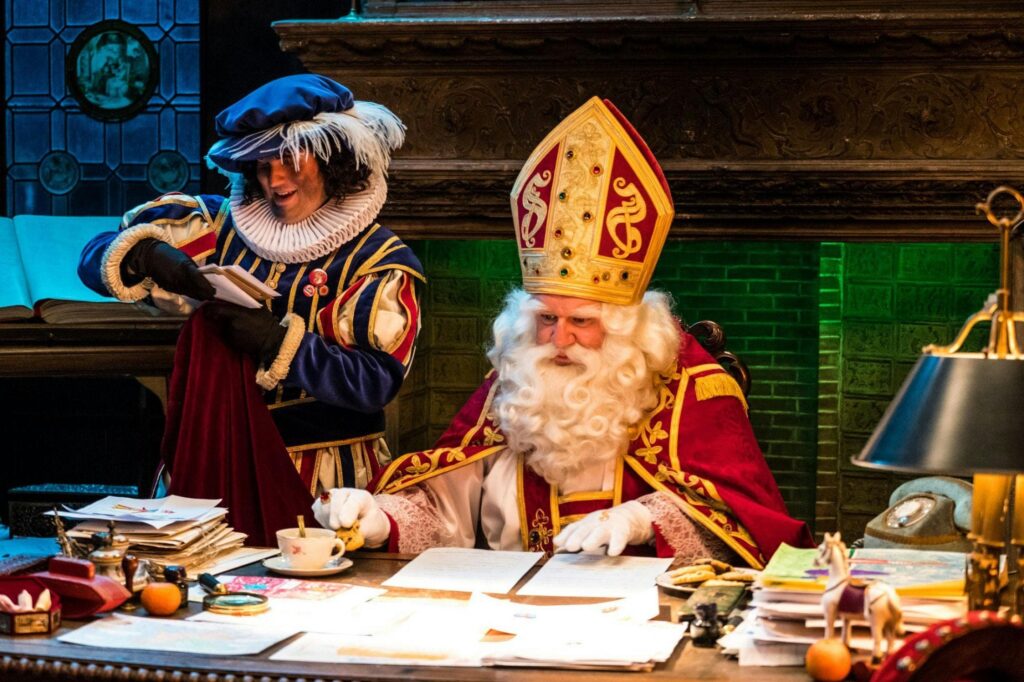
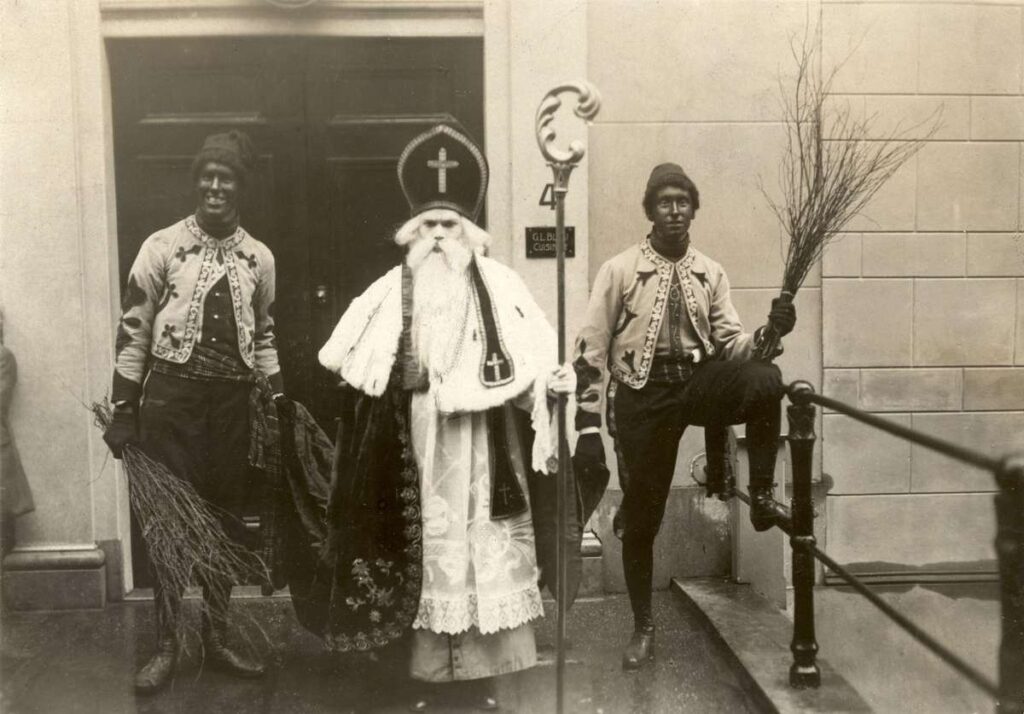
Sometimes I would meet him, he would visit school or other events in that time of year. His ferocious Pieten (Pete’s), with their faces painted black would make lots of noise, trow candy wildly up into the air, jump on furniture and grab you from behind and smear you with black paint or sooth if you were lucky. They would carry large bags and whips (called “de roe”) and ask if anyone was naughty, if you were brave enough to say yes, they would put you in the bag and take you away. When you emerged from the bag they would blacken your face and you would learn that the Pete’s were actually local villagers. You were then in on the secret. You had taken the plunge, you had stood up and confronted the unknown and now you had passed into a new phase, you emerge from the bag a new person, still a child yet a step closer to becoming a man, part of the deal is not to tell the others. Speculoos cookies would be handed out, and chocolate all in shapes of men of the Sint-company but also cookies shaped in the form of letters and cookies called Pepernoot (Peppernut).
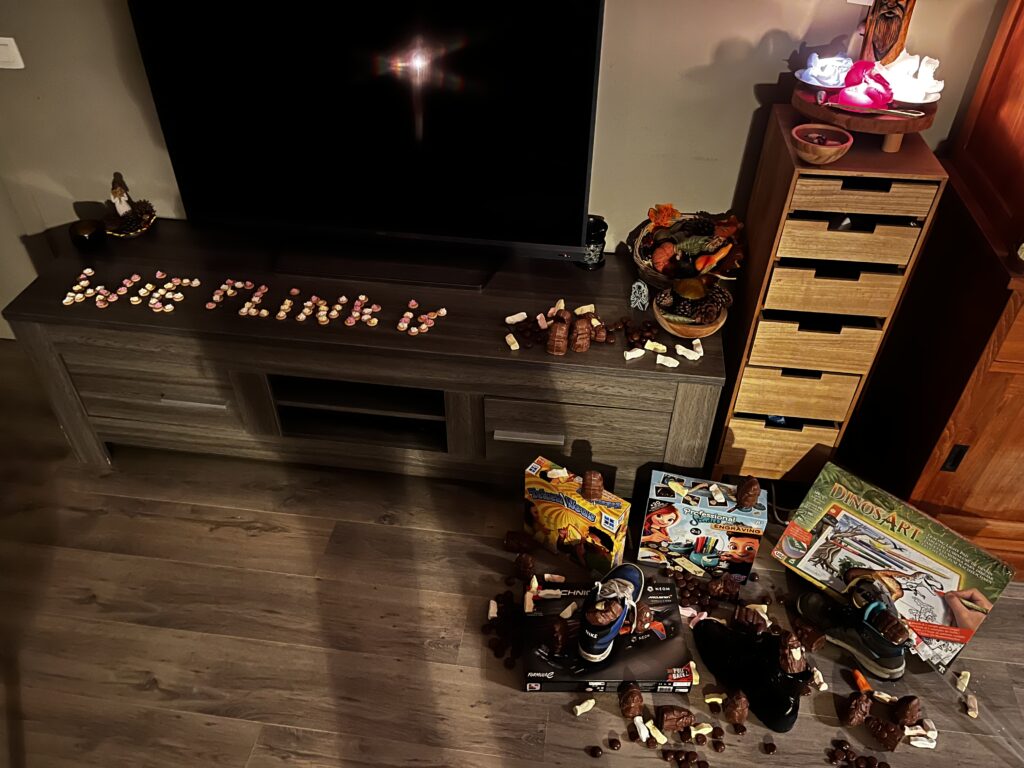
Who was this seemingly old magician on a white horse, assisted by strong but also funny men covered in sooth and colorful clothing? Why did they scare children and reward them? Why do they scatter the cookies often shaped in letters everywhere? Why do we place offerings in a shoe to them?
I always think back to these days of my childhood with lots of nostalgic feelings and I hope that I manage to give my children the same warm feelings, that the magic may stay with them till they too have children.
And today, I still get this same sensation of magic and mysterie when thinking of the Wild Hunt or Het Wilde Heir (The Wild Army), as it is locally known. Sinterklaas is undeniably a version of Wuodan, the visit of Sinterklaas strongly resembles the visit of the warrior band, the visit of the mystical Wild Hunt. And as much as I was fascinated by Sinterklaas, I am now fascinated with the Wild Hunt.
The Hunt will be announced with lots of noise, scary looking men with black faces will steal you away to turn you into an adult.
We recognize elements of the Kóryos, the Männerbunde, warrior bands of indo European traditions. Related to Wuodan, but definitely much older and also seen in Celtic traditions. The coming of age ritual is central here. The child must become a man, and if the child is of the age of daring to take the next step, then he is taken away to be trained by the band. The boy will die ritually and become ‘dead’. He will be inhabited by the spirits of his ancestors, dress in animal skin, not shave or bathe and live outside of the village, outside the community. He is nor man nor child, his is now liminal, a spirit, an ancestor in the flesh.
When the band would visit the village to look for new boys who were ready to outgrow the child, they would be masked, black and they would actually represent the ancestors. They were checking if the village had kept up their discipline and if the children were ready to be introduced to the ancestors and learn of the ways to represent them, to honor them, not only in spirit but also in deeds, in war. It was expected that every house prepared for the Heir to arrive, they would set a table and prepare food and clean up the homestead. The Heir would receive as much food and drink as they want. It was after all their ancestors that came calling. If a household would have misbehaved, they would receive punishment for not showing honor to the tribe, to the dead. The band would pull the shingles off the roof, run havoc in the rooms, pull doors of the wall. During this time of year it was local custom to make cookies and bread shaped like men, as part of the coming of age ritual.
There are many traditions that have mixed or went parallel to these traditions, like Percht and the Host of Children and sometimes hounds in Austria and Bavaria or Frau Selten in Switzerland, and Holle in other regions of the Netherlands and Belgium. People left food out for they believed she would visit the house at night and grant prosperity to the owners if she was well received. Or Gryla in Iceland who goes round the houses with her 13 children who also punish the ones who were bad.
Sinterklaas is of course a Christian figure, a saint also known as Saint Nicolas. His name was first mentioned in 1280: ‘Ic bunre lants… ende heit Senter Claus bunre’ (‘I give a name to the land and call it Senter Claus land’). But when the church introduced him into western Europe they mixed his traits with those of Wodan and a tradition that was alive at the time. The saint was given a whitegrey horse that could fly, the saint was given magical skills such as being all knowing about people and being able to enter houses through locked doors and he would ride across the roofs. Just like Wuodan he brought cookies shaped as letters (master of the runes). He would carry a staf that resembles the spear Gungir. His black faced helpers would carry bags and punish the naughty and reward the good. They would carry sticks called ‘de roe’, of the kind we see in heathen fertility rite. The word ‘roe’ or ‘roede’ (Rod in English), a word used for club but also for penis, and doesnt this roe also represent fertility. In many European countries the rod is used to hit people for prosperity and fertility. In the Netherlands women must jump over the rods held by the Ommegang members. People would have to honor their visit or receive punishment; And this had to be presented in a shoe of the child, the shoe used to be trown on the burial mound, it was a vessel to reach the underworld. The dead would also be dressed in ‘hel-shoes’ to make this trip to the realm.
Wuodan also turns up as the ferryman to bring people to Hel and Sinterklaas is also connected to sailors, fishermen and the sea.
In the Low Lands it was believed Wuodan would ride the sky during winternights to protect the people and land from harmful dark forces to ensure the return of the sun and his men would check the smoke-holes in the rooftops to see if people had put an offering by the hearth for Wuodan’s horse that would get tired from the long nights. Wuodan was associated with the strong wind that could be heard through the chimney. This wind is particularly present in the area’s of the North Sea countries during winter. The protective element of Wuodan is also found in Sinterklaas as patron saint of the unprotected.
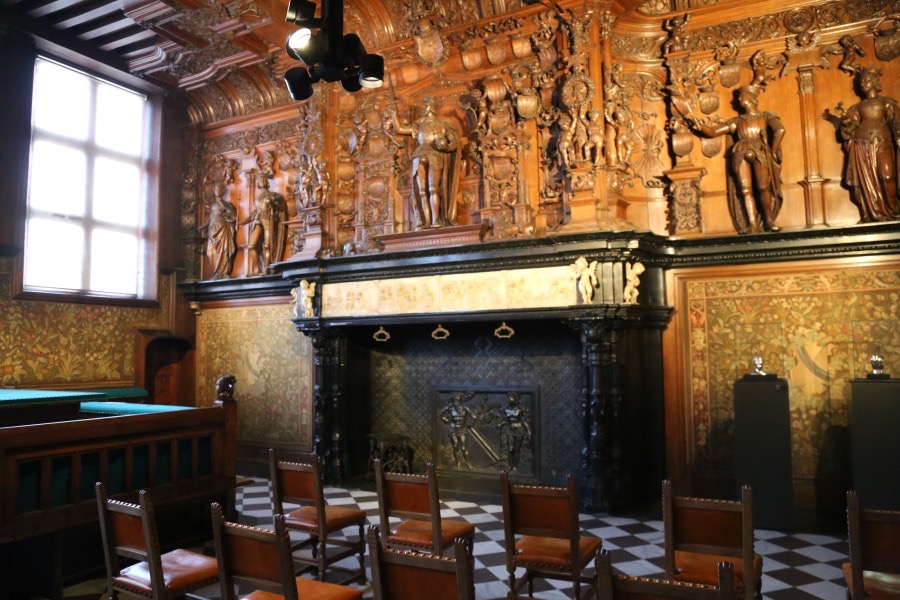
The chimney had always been a sacred spot within the homestead. It was the hole in the roof that connected to the sky, a place of the divine. Even in the 15th century we find references to the magical qualities people believed were held by the chimney. In the book ‘600 jaar Brugs stadhuis 1376-1967’ we learn that in 1435 Karel VII ordered special decorations made for the city hall chimneys of Brugge because of the importance of the meeting they planned to hold there and the magic connecting between the sky and the people ruling the city who sit around the hearth when they meet would have to be of the best quality. The meeting behind closed doors would still be shared with the sky through the hearth and the secretive nature of important talks was trusted to the gods and through the chimney.
At start of winter, around the coming of the Wild Heir, medieval people in Flanders and Netherlands would bake bread and cookies shaped like animals to represent animal sacrifices and later also in shapes of people. Some of these cookies would also be trown around on the fields for fertility. Others would be used to honor Wuodan in representations or offerings. It was said you could tell the path Wuodan and his Heir took during winter, by the crops that grow the highest in spring and summer for where the Heir touches the ground, there it leaves great fertillity.
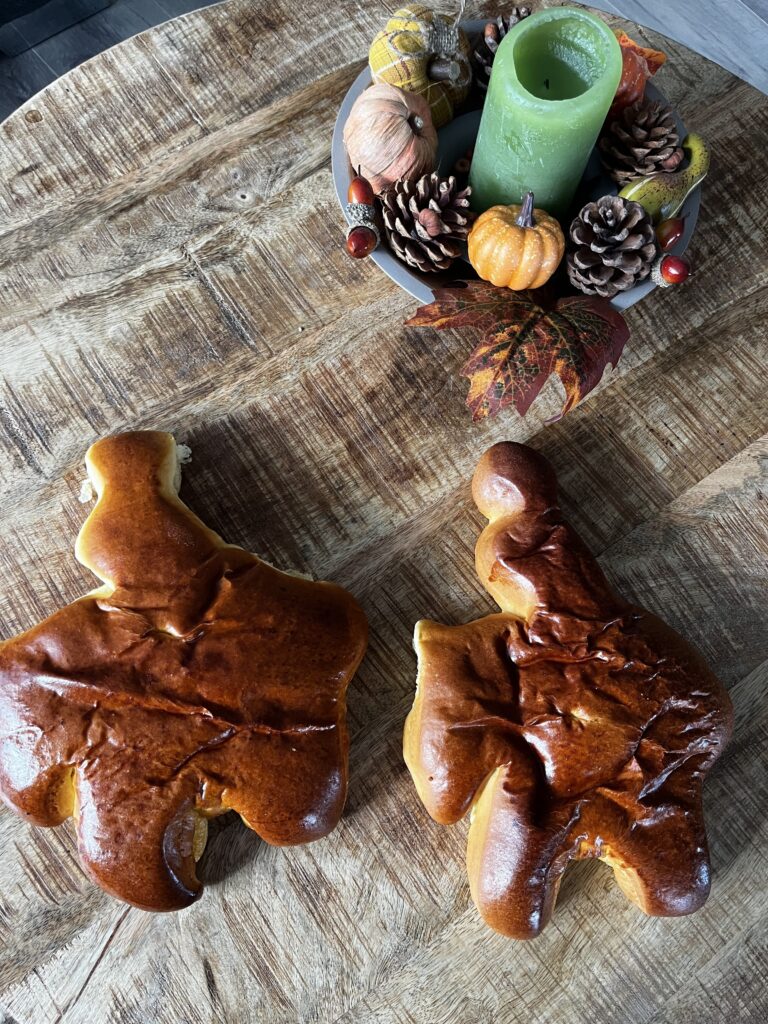
Today we still have these treats during winter and especially around Sinterklaas, usually shaped as a horse or a man riding it. They are known as Klaaskoeken (Klaas cookies), Mantepeirden (Man on horse), Klaaspeirden (Klaas-horses) and made from a very sweet and soft bread. Speculoos and Peperkoek or Zoetekoek (resemble gingerbread) are also part of the tradition. Zoetekoek is known to be a very available sweet cookie in the early middle ages and even in ancient Egypte.
Black faced Pete was first represented by the church as a devil. The devil was always black in the middle ages because the color black was associated with the dead. Going down the rabbit hole of the warrior bands again, we remember the warriors painted themselves black when they became their dead ancestors. In all of Europe, scholars found that during winter times transitional rites possibly related to the dead and to fertility have survived in remote places and have one big common factor: making the face black. In many of those, including Sinterklaas, the black faced men would smear the black sooth on other people. And to receive sooth on the face would bring luck and prosperity in the coming year. A true blessing of the ancestors. Death personified in those days was called Pietje De Dood (Pete Death). Coincidence maybe that Sinterklaas helpers were named after death and painted black. Of course for some time the trend of moors from Spain played a big role too, but this association only could take place a few hundreds of years into Christianity.
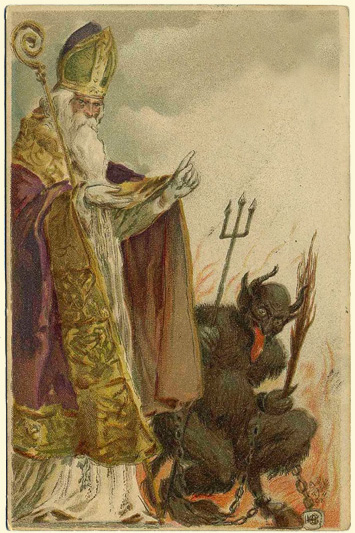
In Germany and Austria and other places, Sint still is accompanied by a Krampus like figure. Of course, the church turned the helpers of Wuodan into devils. They were after all dead and heathen so they must be demonic in nature.
Sinterklaas has turned into a gentile wise old man with funny helpers, but in older days, Sinterklaas and his men were much more feared then in the present.
There are more similarities to compare between practices such as the many mystical folklore customs of Texel, Vlieland, Terschelling, Schiermonnikoog and Ameland. The Sint Maarten, Sunderklazen, Bommels, Carnaval, and the many masquerading traditions in winter from the Ukraine to Italy and from Spain to Germany.
Is Sinterklaas Wuodan? No, he became his own magical entity, well deserved after a thousand years of tradition. Are they related? I am sure, once upon a time, the tradition of Sinterklaas was made to replace a much older tradition that was hard to extinguish by the church. One of many germanic traditions the local pagans were reluctant to let go of.
The Coca Cola Company created a version of Santa Clause that took over the world of which his main treats are based upon Sinterklaas. Even in countries where Sinterklaas customs are practiced, Santa Claus also found its way in. So children get two magical visits with gifts in December here.
Now tidy up your hearth, prepare your shoe and offerings, for he is coming and he knows everything!
Sinter Greef
We established, looking at Sint Maarten and Klaas, how it is tied to pre-Christian culture, today we will look at a parallel Sinter Greef, often in company of his wife “Grevin”, both whom were never Christianised.
Despite the term ‘Sint’ which means saint, Greef is in no way a catalogued catholic saint. Sint was added by the people in the 19th century because the character’s activities resemble Sinterklaas soo much. Before that he was known as De Greef or Greif or De Graaf van Halfvasten (the Count of Half-Fasten – which was the time of the end of winter and so the time of carnival) and he would also have a female compagnon known as De Grevin. It seems likely that the Grevin would have been his wife much like Frigg was the wife of Odin. He rides a white horse and brings gifts to people. His task would be to kick out the winter and open the way for spring to come in.
A number of songs survived the passing of time, were song in honor of Greef, I ll give you two:
“Kinderen, zet uw körfkens uit,
De Greef zal morgen komen;
Ja, de Greef, Uwe neef,
Die zal morgen komen.
De Greef, Wat heeft hij meegebrocht?
Vijgen en rozijnen,
Kammen en mes
Scheren en tesch
Brengt hij met heel dozijnen,
Naar al die vroeg slapen en gaat,
Daar zal hij niet mee moeien,
Daar zal de Greef, Uwe neef,
Brengen ‘nen körf met roeien.”
And
“Wad heit de Greif ons gebrocht?
Strikke en messe, koeke mê gehiele dozane.
Ga goeie brauve Sint, altaud vroum en blaa gezind, brengt wa in ons talloer.
Zend den eirreme ni vandeu , brengt wa lekkers en faun, ’t zal wel gekoume zaun.
Een appelke veu den deûst en een massepaune weûst, een van sooker gebakke klokske eb een tikkenheûntje op ien stoksken.”
Both songs discus the gifts by Greif: they speak of raisins, figes, apples, cookies, combs, knifes etc.
Striking too is that Greif is also said to be ‘your cousin’. This insinuates a close family tie, a relative with supernatural powers? An ancestor?
We also see the words ‘tikkenheûntje op een stoksken’ which means a cock on a pole. The cock is an old symbol from germanic mythology and is omnipresent in the Netherlands, Belgium, Germany and other nearby countries. The cock shows up on buildings mostly but also in old art paintings of easter celebrations and in sources. The church even decided that all their church towers should have a cock on the top as wind vane. (I made a separate post on this subject).
In area’s were Greif was celebrated, bakeries would make cookies in the shape of a cock on a pole. Professor Lecouteux has offered that the cock is one of the heathen symbols that survived time and cultures. He was offered as a building sacrifice, even under Christianity. The cock protects and provides overwatch to warn for danger. He is Gullinkambi.
Greif would trow his presents down the chimney. It was expected that the children would offer food and drink for Greif and his horse by the hearth. This is much the same with Sint Maarten and Sinterklaas, so albeit a different figure and development in history, the practices were the same. The hearth is a connection between the homestead and the sky above. Considering that Wodan was believed to travel in the sky on Sleipnir with the his dead army, the chimney could be helpful to reach out to him. We know in the old hearth culture it was common to burn offerings and let the smoke bring the offering to the god in the sky. Lecouteux draws a parallel here with witches and sorcerers using kettles to cook or burn strange ingredients to perform magic. The smoke it produced would also reach through the chimney into the sky above.
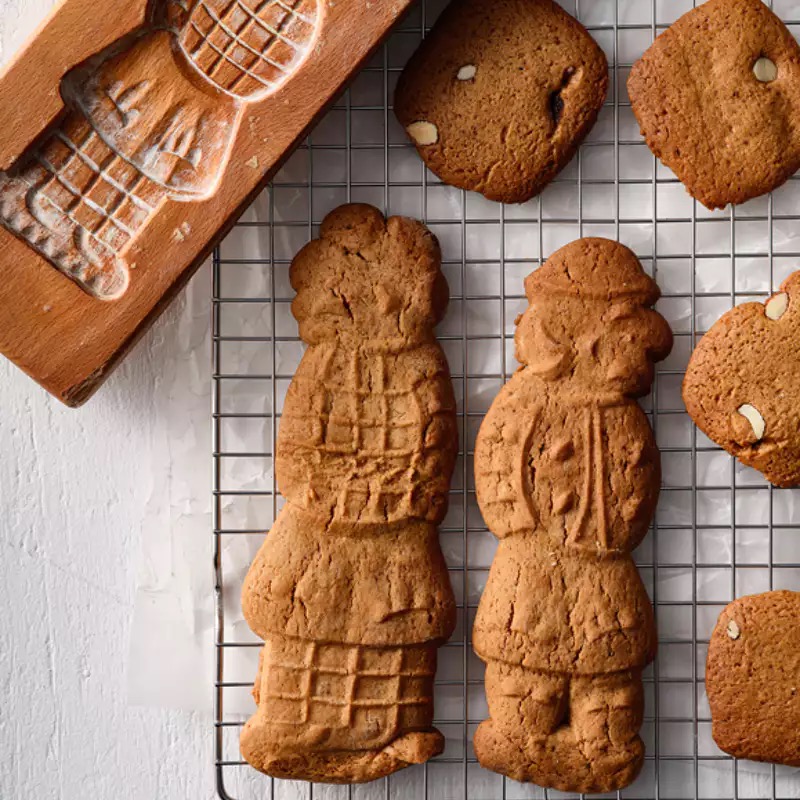
Speculaas is the traditional cookie made for Greif, but also the other midwinter Ommegang leaders. There is much to be said about this traditional food and it really deserves an article on its own. But know that speculaas is a very old cookie found in the west of Germany, in Belgium and Netherlands and north of France. It is made representing a Ommegang leader and his company or animals offered to him. The church regularly tried to ban the use of this cookie, but failed and so incorporated it into their own ways. Evidence of this in several sources, most famously probably in the 8th century Indiculus superstitionum et paganiarum.
Greif would shout “Hoo” or “Hoe” to announce his coming over the rooftops. This is found in very old songs about Greif and sounds a lot like the modern way of Santa Clause calling out ‘Ho-Ho-Ho’. We can trace this back to the Wild Hunt or the Wilde Heir, the army of Wodan, who would announce their passage by this same shout, so that people be warned for their coming. Because to see and meet this company would also mean you would soon be dead yourself.
The first world war and also the second, sadly had devastating effects on old traditions because a lot of this activity would come to a standstill during the years of war and occupation. Before 1914 there is evidence of the custom of using hollowed out beet and putting candles inside them and are then carried by a company during an Ommegang. The company would be lead by Greif and consist of a number of masked people, who would use a cart or even a cart disguised a ship. Interestingly a marzipan ship would also be eaten at the feast of Greif and there is yet again a parallel with Sinterklaas who arrives in our land by ship and here too Marzipan is one of its traditional foods.
And the ship brings us back to Wodan, for the ship was a way to travel to death and the ferryman is after all Wodan. In Dutch the word for funeral is still ‘uitvaart’ which means ‘sailing out’.
So Greif comes leading a ship with masked men, of whom we know in germanic culture to represent the dead.
The paralells with Wodan and his Wilde Heir are very central. Even in Tanum there are 3000 year old depictions of ships drawn by a horse.
In midwinter, Wodan rides out, and he brings us the dead. They check our community and reward or punish accordingly. They grant gifts, fertility or wealth, or they take it away. Honor and luck, offered by our ancestors and their wise all-knowing leader.
Make sure to prepare your hearth, make a fitting offer and set ready a chair and plate, the Wilde Heir is on the way.
 Written by
  Written by