 Written by
 A while ago, I discovered that a team of archaeologists and forest rangers had found a Saxon sacrificial site in the Springendal, a beautiful wooded area in Twente bordering the German state of Lower Saxony.
Naturally, that piqued my interest! After all, it is not often that we simply dig up physical pieces of heritage from our Germanic past. The excavation consisted of a number of coins, presumably of Frankish origin, as well as pieces of precious metal of various sizes.
These were found in the ground, and soil research has shown that these treasures were buried in front of wooden posts. Those wooden posts are believed to have been representations of the Germanic Gods.
Below, I am briefly sharing the video from the Rijksdienst voor het Cultureel Erfgoed – The Dutch official Cultural Heritage Agency – regarding this:
My journey through Saxon-Netherlands
With this knowledge in mind, I began my journey through the Saxon language region full of enthusiasm. In my case, that was from my home region of Salland to Twente – both areas within the Dutch province of Overijssel with a bit of Low Saxon – one of the states of Germany. It was a beautiful drive through the small villages and lovely forests and meadows of this area.
It felt as if time moves more slowly in this region than in other parts of the Netherlands. As if the echoes of the past may still be heard by those who are willing to be open to them. With my journey to this area, I wanted to open myself up to the realities of my Saxon ancestors.
Echoes of our Saxon ancestors can, of course, best be heard when we have a picture of who they were!
So, in short, a quick history lesson!
Who were the Saxons?
The name “The Saxons” – or Saxones – appears in various sources.
According to Roman authors, the Saxons came from the North German region, which we can roughly designate today as the states of Schleswig-Holstein and – naturally – Lower Saxony! This makes them an Ingvaeonic people, as they lived on the coastal region of the North Sea and therefore interesting for our purpouses.
The Romans viewed them primarily as a kind of “proto-Vikings,” because at the beginning of recorded history they raided the coastal regions of Gaul and Britain, roughly the present-day United Kingdom and France.
Later in the Middle-Ages, these Saxons expanded their territory by incorporating other tribes into their tribal confederations. It is unclear to what extent this progressed, but it is not unreasonable to imagine a mixture of peaceful unification and violent conquest.
As the Middle-Ages progressed, the Saxons put up strong and courageous resistance against the forced Christianization by the Frankish troops. In this, they were also supported by the Danes, which suggests some connection with the Scandinavian region. Unfortunately, the Saxons eventually had to give up that struggle and were subsequently incorporated into the Empire of Charlemagne.
However, their legacy still resonates strongly in contemporary Dutch, German, and Danish cultures. See, for example, this language map of the Saxon language area:
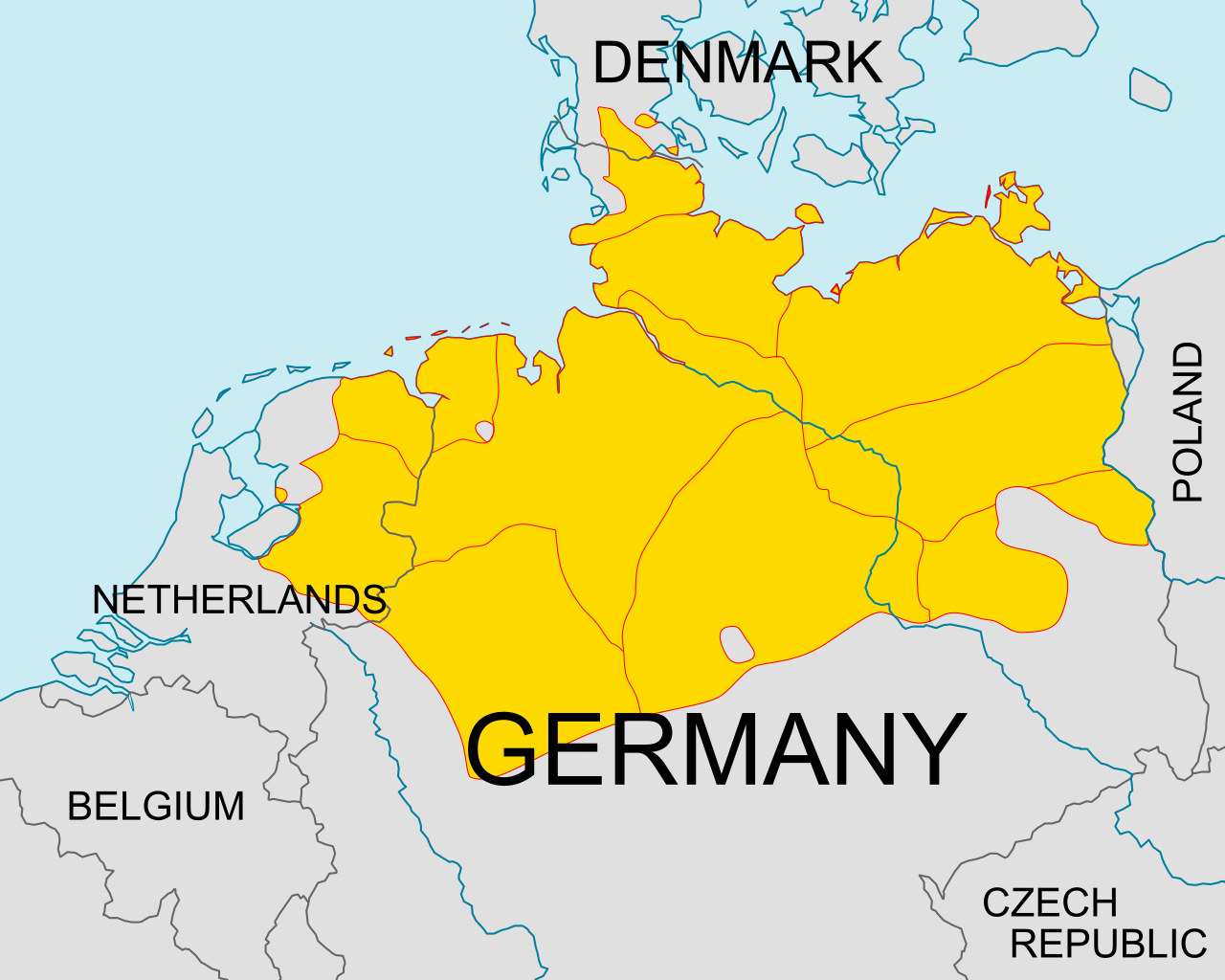
From this, one can conclude that the Saxon language area still exists to this day. Many local dialects found in these regions are therefore not Dutch, not German, not Danish, but Low Saxon.
It is this author’s opinion that the people’s of this area can be proud of that!
Between the woods and meadows to Wodan
After completing my journey through the Saxon region, I arrived in a wooded area. It was a rolling landscape with small patches of forest alternating with stretches of open field. Nestled between these natural areas were small villages featuring that typical Twente architecture.
It could hardly get more idyllic, or so I thought to myself!
After parking my car in a local parking lot, I noticed that I wasn’t the only one there that day. After all, it was a beautiful Easter Sunday, and many people were out for a walk, while some children were playing.
The forests themselves felt very “cheerful,” truly as if Ostara had lovingly laid down her spring love over the hills and valleys of the Twente landscape.
Fortunately, I didn’t have to walk far to find what I was looking for.
Not far from there, the sacrificial site was found, and it is marked by an important work of art created by forest ranger Albert Broekman. It consists of a simple wooden statue flanked on both sides by wooden posts.
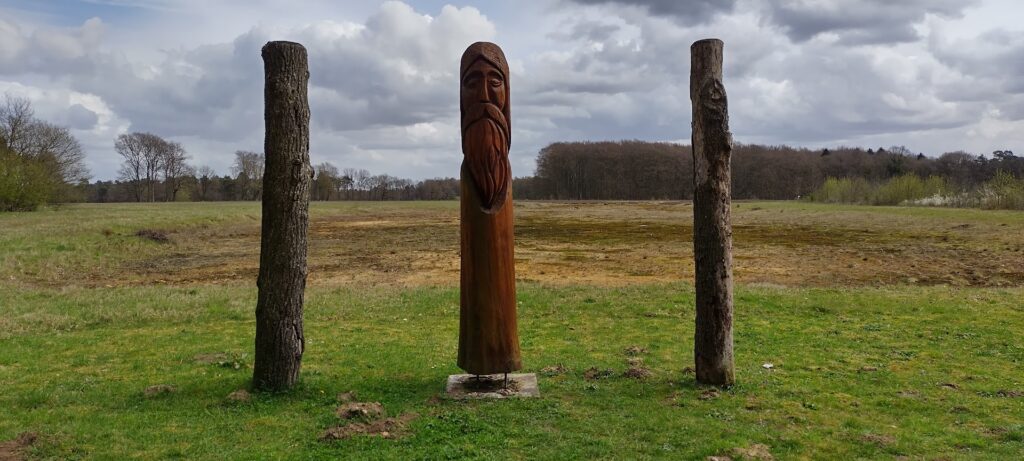
With this relative simplicity, we gain a unique insight into the Germanic past of our Saxon ancestors. It is not unreasonable to imagine that the statues our ancestors made in honor of our Gods did not look very different.
Sacrificial rituals were often performed at the foot of these types of statues. The statue served, as it were, as a kind of connection point between our ancestors and our Gods. It was a focal point where our ancestors could pray in gratitude for the past year and pray for blessings for the coming year.
Given that prayer is communication between humanity and a Deity, these statues are often made with a human face. It might help with the connection for us humans if the person we are conversing with has a human face. We humans tend to anthropomorphize quite a bit after all.
But not only was a simple work of art gathered there, but an interesting information board providing additional information was also placed there, featuring a piece of the Pagan history of the Netherlands.
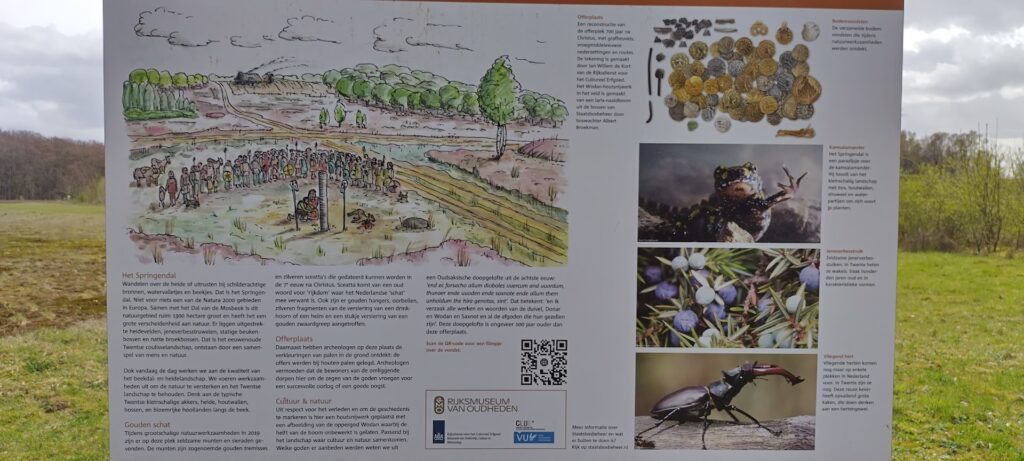
Ancestors, never forgotten, always present
Given that it was a beautiful day, I decided to continue walking through the woods and meadows of the area. There was an atmosphere of cheerfulness in the landscape, and I saw many small birds flying around me.
Spring was in the air, that much was clear!
When I eventually got a little deeper into a forest, I came across a bump in the landscape to my surprise! I walked towards it, and in my opinion, it really did look like a burial mound, although unfortunately, it was not marked as such.
This type of burial mound is very common in the Netherlands and was a burial custom of our ancestors for a long time. It is not clear to me whether the burial mound in question was Saxon, Orde-Germanic, or perhaps Pre-Germanic, but perhaps research will be conducted someday that can provide information about this beautiful monument.
In any case, it was a beautiful place to behold:
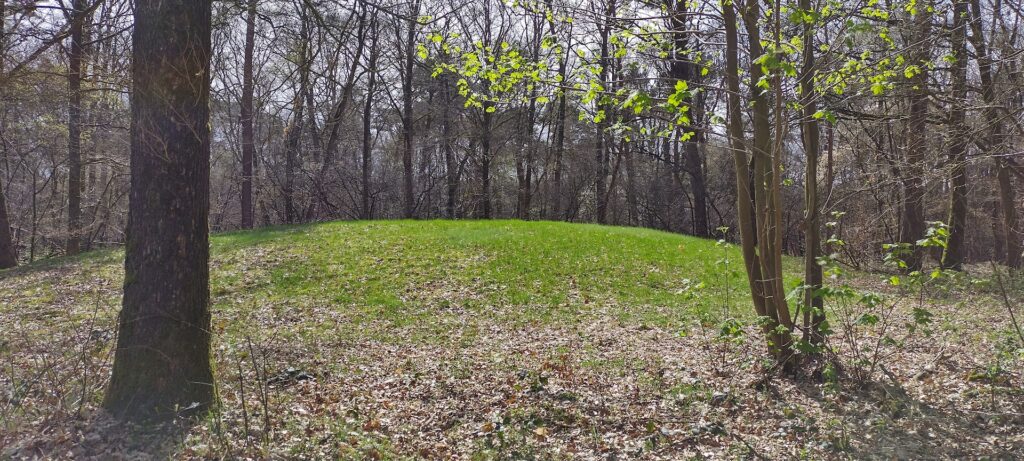
Traces of Modern Heathens
After completing my walk in the woods, I returned to the Saxon sacrificial site. I wanted to examine the excavated ground to stand where my ancestors once stood. Connecting with them in this way was a beautiful experience.
However, when I entered the excavated ground, I encountered a very special, simple little structure. It was a spiral made of rocks and stones, presumably from the local area. A spiral has a spiritual significance and symbolizes, among other things, the journey into one’s inner self.
Given that it was most likely not excavated from the ground but was recently placed there, I suspect it was made by Modern Pagans. I am very curious about who made this spiral and whether they hold rituals there.
However, it suggests to me that Modern Paganism is manifesting itself in those places that were once important to our Pagan ancestors and are now important to us again.
There is a connection within this between what once was and what is yet to come.
The Return of Paganism therefore continues unabated!
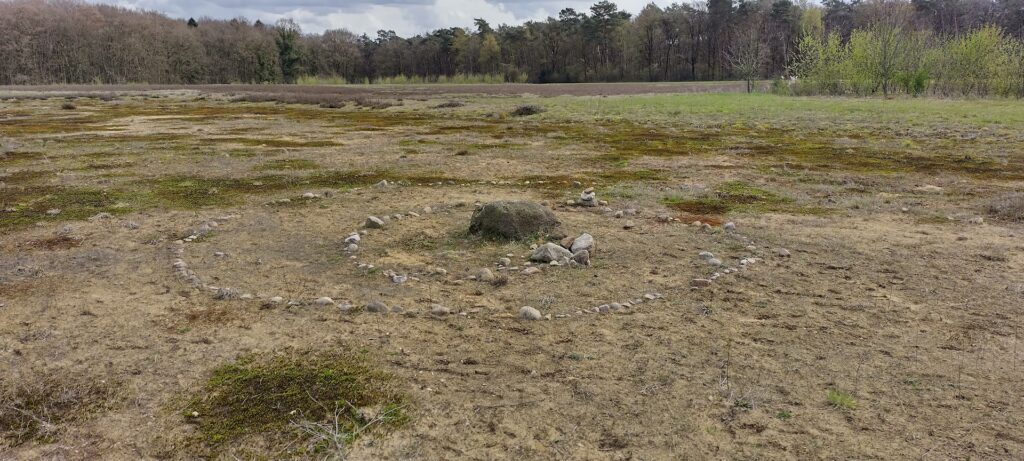
On making sacrifices in public
During this trip, I personally performed a public offering. In doing so, I donated some food and drinking water from what I had brought along to the Gods, ancestors, and spirits of the land.
For Modern Pagans, these are very common practices, but given that it took place in public—and I was alone—I had to exercise some discretion to avoid attracting too much attention from others.
For although we are experiencing a quiet rise, Modern Paganism is not yet established in modern Dutch society.
So, if I leave whole bowls of fruit there, for example, people might look at me very strangely!
Not only that, but making offerings in nature requires careful consideration due to the inherent biodiversity of the area as well as stray dogs.
Personally, I view it as an inherent respect to the spirits of the land to make offerings that fit into the landscape. Doing a little research beforehand can help, but generally, these offerings are often quite appropriate:
Small pieces of apple
You can make a beautiful ritual offering of this by “killing” the apple by cutting it on the spot.
Bird food
Not all types, but simple bird food that you can hang in your garden, for example, is generally common.
Oats
This usually goes well; however, do not offer too much as it might attract many mice. That is less pleasant for the people living nearby.
Clean drinking water
This might be less “fancy,” but all plant species respond well to a gift of life-giving drinking water. Especially when it concerns your own bottled water, you are donating a portion of your water to the nature that has received you so beautifully. You really can’t go wrong with an offering of water!
However, do not offer too much, otherwise you will become dehydrated yourself.
On making offerings in a group in public
Everyone feels safer in a group, especially when it concerns religion in public.
It is my conviction that it is perfectly fine to hold rituals here in a small group; after all, it is a sacred place for us Pagans.
Especially when the group rituals are conducted discreetly, I do not believe we will be much trouble from people outside our path. Do not forget that if we do this in public, we all become ambassadors for Modern Germanic Paganism. A certain degree of good conduct towards others in the vicinity is then a fine calling card for our faith in my opinion.
Let them see how hospitable, pious, and friendly we Pagans can be!
Back to Salland to conclude
After completing my walk in this sacred area, I started my car and began my journey back to Salland.
I briefly slipped across the border to refuel in Lower Saxony, which is always cheaper, of course! 😉
The surrounding area is highly recommended for driving through at a leisurely pace. It guides you past beautiful lakes, small streams, and stunning fields that give you the feeling that nature has never been far away. The people there are also very friendly!
Ultimately, this adventure has taught me once again that the traces of our Germanic past are not far away, nor that these traces belong solely to the Netherlands. The jewels found as offerings are of a form that we have also found in Friesland, Holland, and even as far as Denmark.
This suggests to me that our Germanic ancestors were in continuous contact with one another and that the areas encompassed by their territory were not cut off from the outside world. They were an integral part of the world. It is also nice to know that such a beautiful Pagan area exists in our own country. For me, it is not far away, but for others, it might be a bit further.
Nevertheless, I am happy to share the exact location on Google Maps so that you can make a pilgrimage to this area yourself if you are capable.
I personally recommend visiting it on a beautiful spring or summer day!
Oh, and don’t forget your offerings! 😉
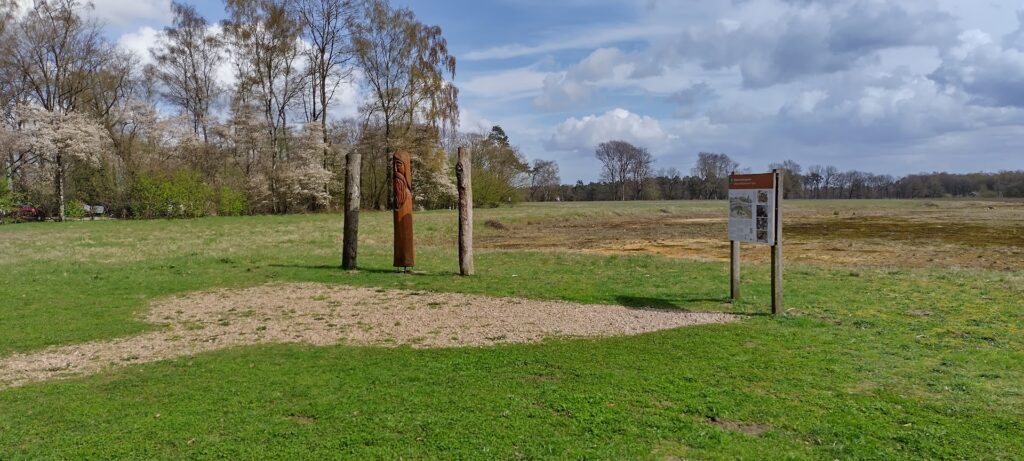
 Written by
 Written by