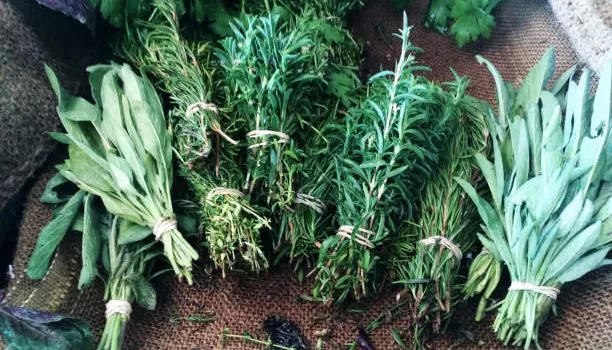
Summer herb gathering day in August
-
AuthorPosts
-
-
July 25, 2025 at 10:12 am #5294
 OsricKeymaster
I’d like to make this post to open the discussion on a possibly official or semi official herb blessing to take place on or about 15 August, preferably for magical purposes the full moon of Weodmonaþ.
Sources to explore:
Lorsch Leechbook
St Gall Botanicus
Capitulare de Villis
Plan of St Gall
Fulda Liturgical Calendars
Gelasian Sacramentary
St. Gallen StiftsbibliothekAlso of interest the collected works of Cockayne, Grimm and scholarship around euhemerism of Frig as “Mary” in Germanic contexts.
-
July 25, 2025 at 10:17 am #5295OsricKeymaster
🌿 Hælgwyrt-tīd: Reclaiming the Pre-Christian Roots of the Herb Blessing Tradition
In the modern Heathen revival, many of us are rediscovering the sacred rhythms that once shaped life in pre-Christian Europe. One of the more enigmatic survivals is the mid-August herb blessing ritual known today in German-speaking regions as the Kräuterweihe—a tradition preserved under the banner of the Virgin Mary, but likely rooted in something far older.
As we strive to reconstruct Heathen practice with historical integrity and spiritual resonance, this tradition offers a compelling opportunity: to honor the goddesses and wights of land and herbcraft in their proper season—around the full moon of Weodmōnaþ (August), or for simplicity, on the 15th of August.
⸻
🌕 The Season of Weeds: Weodmōnaþ
In the Old English calendar, Weodmōnaþ—“Weed Month”—was the time when wild and cultivated herbs reached their full strength. Anglo-Saxon sources recognized this month as one of transition: the grain harvest had begun, but the power of the green world had not yet waned. It was a time to gather and bless herbs for healing, protection, and spiritual aid.
In modern folklore, particularly in Germany and Austria, this tradition survives as the Women’s Thirty—a thirty-day period of herb gathering by women following the Feast of the Assumption (August 15), when healing plants were collected, blessed, and stored for the dark half of the year. This custom likely echoes an older cycle of women-led ritual deeply embedded in the agricultural and spiritual life of North Sea peoples.
⸻
👁️ The Goddesses Behind the Veil
With Christianization, many sacred beings were euhemerized—explained away or rebranded as saints or aspects of the Virgin Mary. Among them, several goddesses of water, herbs, and protection likely stood behind the medieval and modern “Mary” of herb-blessing lore:
• Frīg (Old English Frigg): Lady of foresight, domestic harmony, and herbal wisdom.
• Hludana: A water deity known from Roman inscriptions in Frisia and Germania; possibly linked to healing and seasonal offerings.
• Eorðan Modor (Earth Mother): Source of fertility and growth, invoked in charms like the Æcerbot.
• The Ides (Dísir): Protective female spirits connected to fate, family, and health.Where Marian veneration filled the vacuum of pre-Christian devotion, these beings still linger in the background—goddesses of herbs, healing, and harvest whose rites were too deeply rooted to be erased.
-
July 25, 2025 at 1:33 pm #5299
 HirutParticipant
On various herbalist and Catholic websites, I find hints at a rich history of this tradition. Here’s some information that might help you explore this custom.
The “Kroedwusj” Blessing Tradition
On August 15th, the Catholic Church celebrates the Feast of the Assumption of Mary, marking her ascent to heaven in body and soul. Mary, representing the feminine and nurturing aspects of the faith, is seen as the spiritual mother of all believers.
In many Limburg villages, a traditional herbal bouquet — known as the Kroedwusj — is blessed either on or before August 15th. This ritual bouquet, tied with light blue ribbons of seven ells in length, consists of at least seven specific herbs and grains, believed to protect against lightning and other misfortunes. The herbs are gathered on August 14th, before sunrise and only by hand, as metal was believed to break their magical power.
After blessing, the Kroedwusj was often hung in the attic or stable until a thunderstorm occurred. In times of danger, people would throw a few sprigs into the hearth while praying to Saint Donatus, the patron saint against lightning, or reciting the Gospel of Saint John — especially fitting since St. John’s wort is a common ingredient in the bouquet. This practice reflects the belief: “If there is thunder and rain, then the storm is blessed.”
This ritual is an example of a pre-Christian custom that was absorbed and Christianized by the Church. The act of burning herbs in honor of Thor (Donar), the Germanic god of thunder, was transformed into a Church-sanctioned blessing directed to God, the creator of all vegetation.
The blessed bouquet also had practical and symbolic purposes:
Fertility charm: In some areas, women hoping for children would keep a blessed bouquet. This is echoed in the Maastricht saying: “She has received her herb bundle”, meaning her wish for a child has been fulfilled.
Agricultural use: Farmers sometimes took seeds from the blessed bouquet and scattered them on their fields before sowing.
The seven components in the bouquet often include:
2 grains (e.g., wheat, rye, oats)
2 healing herbs (e.g., yarrow, chamomile, valerian)
2 protective herbs against lightning or evil (e.g., mugwort, St. John’s wort)
1 walnut leaf, as a symbolic plant with seven leaflets
Regional variations exist, but common herbs include tansy, wild marjoram, mugwort, wormwood, and tormentil. In some places, people also add apple or pear branches, clover, goldenrod, and Palm Sunday-blessed boxwood.
The number seven symbolizes completeness and is deeply rooted in both pre-Christian cosmology (seven classical planets) and Christian theology (seven sacraments, seven days of creation, etc.).
This custom, known since the 9th century (maybe even earlier ) ,remains vibrant in many villages, such as Tongeren, Eifel, Valkenburg, Klimmen, and Schaesberg, where outdoor masses still bless the bouquets each year.
-The Brothers Grimm (in their Deutsches Wörterbuch) noted the “Kräuterweihe” (herbal blessing) as a Christian rite with possible pagan roots.
-Kräuterweihe: This custom has been known since the 9th century [1] and has become more popular again in recent years. Typical herbs, besides elecampane, include St. John’s wort, wormwood, mugwort, tansy, yarrow, mullein, chamomile, thyme, valerian, vervain, and various grains. The tea made from these consecrated herbs is said to be especially healing.
-In Central Europe, this season is even known as the “Frauendreißiger” — the 30 days (August 15 – September 12) during which herbs are believed to hold the greatest healing power.
Attachments:
You must be logged in to view attached files. -
July 25, 2025 at 2:15 pm #5307HirutParticipant
Some more info about Sint Donatus https://en.m.wikipedia.org/wiki/Donatus_of_Muenstereifel
Attachments:
You must be logged in to view attached files. -
July 25, 2025 at 3:21 pm #5310OsricKeymaster
I wanna highlight the relevant text that Hirut pointed out in discord:
*** In times of disaster, a few twigs were thrown into the hearth fire.
Prayers to Saint Donatus, patron saint of thunderstorms, were often said, or the Gospel of St. John was read. This
is because St. John’s wort is also found in the kroedwusj.
This custom recalls the burnt offering made to the thunder god Thor (Donar) in the time of the Germanic people. The herbs were also used as medicine for humans and animals. ***
-
-
AuthorPosts
You must be logged in to reply to this topic.