 Written by
 by Tom Fernee
It is often asked whether or not the heathen Anglo-Saxons had a sacred direction in which they faced during prayer and ritual.
Although there is nothing explicit in written record, at least not yet which states the sacred cardinal direction I would like to propose a theory based on records which could at least hint to what this direction could have been.
Before we delve into the details of passages from various texts let us recall what Gregory the Great’s advice to Abbot Mellitus was regarding on how to conduct his mission to pre-Christian Anglo-Saxon England— that was to empty the temples of idols and heathen sacraments, and replace them with Christian iconography and sacraments; to leave intact the heathen temples by resorting to familiar places they might learn about Christianity (Bede, Pg.65).
This practice of accommodation rather than coercion or outright preaching, although allowed the Catholic Church to make inroads to conversion of the Heathen Anglo-Saxons resulted in a modification of Christianity to conform to the heathen world-view. The idea was that over time other concepts would be introduced by the Church to better re-align this modified Christianity to more resemble the form of early Christianity. In practice the objective definition of Christianity was more so rendered to a relative definition as the church was seeking to incorporate much what was pagan into Christian life (J.Russel Pg 209-212).
This concept of accommodation through modification of the original definition of Christianity to suit the Germanic heathen provides an explanation of how we find charms and field remedies in which many of the actions appear very pagan, whereas the incantations and hymns appear Christian on the surface.
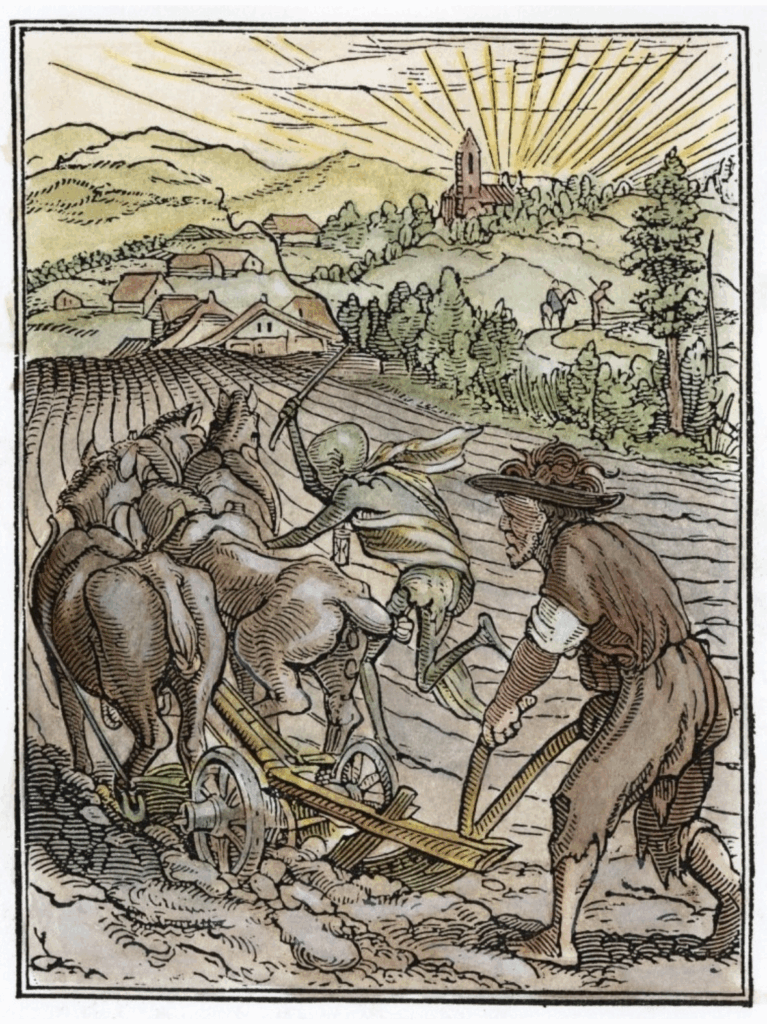
Hans Holbein the Younger “Death and the Plowman.” 1526
If it was believed that if a field remedy was effective enough to yield good crops, and by so removing a passage to the sun could deter its efficacy a compromise would be made with at least partial Christianization of the passage (G. Storms Pg 179).
The Æcerbot field remedy is a great example of this phenomenon as worship of the Earth is evident in the charm, the following lines appear to be a hymn to Mother Earth:
“Erce, Erce, Erce, earth’s mother,
May the all-ruler grant you, the eternal lord,
fields growing and flourishing,
propagating and strengthening,
tall shafts, bright crops,
and broad barley crops,
and white wheat crops,
and all earth’s crops.
May the eternal lord grant him,
and his holy ones, who are in heaven,
that his produce be guarded against any enemies whatsoever,
and that it be safe against any harm at all,
from poisons sown around the land.
Now I bid the ruler, who shaped this world,
that there be no speaking-woman nor artful man that can overturn these words thus be spoken” (G.Storms Pg 10-11).
It is however lines 28-32 of this charm which leads me to believe that the east is a direction of particular liminal space or sacredness, and possibly the direction of prayer for the Heathen Anglo-Saxons:
“And then turn to the east and bow humbly nine times and then say these words:
Eastward I stand for favours I pray:
I pray the Great Lord, I pray the mighty prince
I pray the holy guardian of the heavenly kingdom.
Earth I pray and sky.”
East being the direction of the sunrise, these lines demonstrate an outstanding instance on sun worship in Anglo-Saxon magic. Further more the author states “Turning round with the course of the sun was a typical device in magic to propitiate the sun deity” (G.Storms pg.6-7).
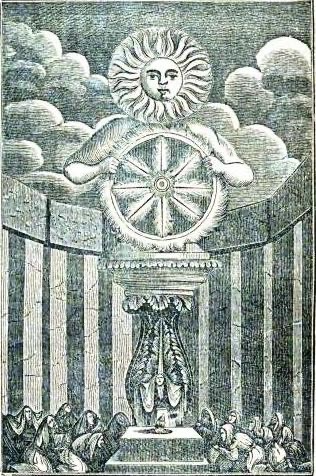
Richard Verstegan “Idol of the Sun, a Saxon diety.” 1605
There are of course other instances in which the direction of east is mentioned or possibly demonstrated with such significance in historical and archaeological record of The Anglo-Saxons besides incantations and charms. They were a culture which buried their dead with grave goods, which are personal possessions of the deceased which bare significance in that they to assist the dead with their journey to afterlife or provide offerings to the gods (I.Morris Pg.17)
If death is a time when the deceased travel to the afterlife perhaps it might be significant that according to archeologist David Wilson with [Anglo-Saxon] pagan inhumations the usual orientation is with the head to the west and feet to the east (Pg. 87) In addition the body of the Sutton Hoo burial mound 1 might have the same orientation based on the way objects were placed in the grave (Bruce-Mitford, Pg. 683–717).
Another possibility of east being a sacred direction for the pre-Christian Anglo-Saxons is demonstrated in a community heathen ritual by the continental Saxons:
“When morning came, the Saxons placed an eagle before the eastern gate, and constructed an altar of victory following the error of their fathers*.They worshipped their divinities in their own manner. “ (Deeds of the Saxons, Widukind of Corvey pg.22)
*the author states “following the error of their fathers” as the practitioners are of course pagan.
The Saxons placed their eagle—which is the banner they brought into battles, at the eastern gate in the morning, so that it would be at the direction of the sunrise while they worship. It sounds like the eagle banner could be a part of their altar at which they worshipped their divinities, so when they worshipped they would have been facing east.
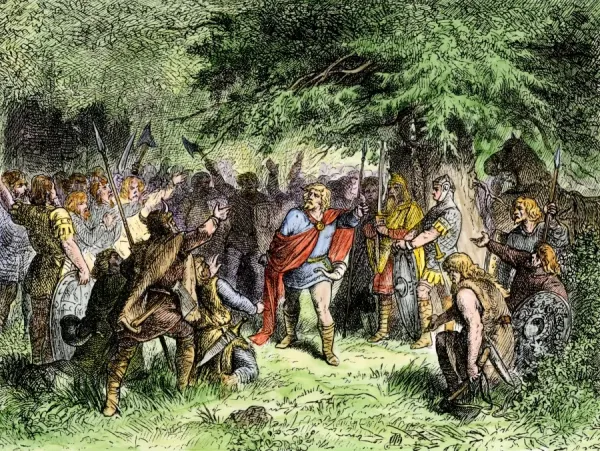
Unknown Artist “Widukind of Saxony calling upon his Saxon troops to fight against the army of Charlemagne”, 19th Century
A passage on the page before may give you an idea of the profundity and sacredness of the object:
“At that time, there was an older man among the veteran soldiers in camp who, despite his age, was still vigorous. By virtue of his achievements, this man named Hathagath, was called father of the fathers. He grabbed up a banner, which they held sacred, bearing an image of a lion and a dragon above whom was flying an eagle. It was intended to show the intensity of their bravery, prudence, and other virtues. Making clear his resolve through his upright posture, Hathagath declared: ‘Up until now, I have lived among the best Saxons, and age has brought me to this, the penultimate stage of life. I have never seen my Saxons flee. How can I now be forced to do what I never learned? I know how to fight. But I do not know how to flee, nor do I wish to. If the fates do not permit me to live longer, at least they grant what is sweetest to me, namely to die with my friends…” (Widukind of Corvey, Pg.22)
Hathagath may have been a Sacral King (K.Hauk pg.217-218), to put it simply a king of divine origins, here he was holding the sacred banner while he gave a speech to rouse the Saxons to fight the Thuringians.
Therefore a sacred object wielded by a sacred person or being, which was placed a location; eastward, during sunrise to demonstrate the object’s sacredness. Obviously a sacred object would not be kept at a mundane location, for if it was such would disrespect the object, the king, and therefore the tribe.
Further associations regarding the east being a sacred direction— the prayer direction, and divinity may be found in the examination of the goddess Eostre, mentioned by Venerable Bede in De Temporum Ratione, in which he recorded the Month Eosturmonath as being named after their goddess Eostre.
Other evidence for the goddess’ significance and sacrality includes personal names such as “Eostrewini”, “Easterwine”, possibly meaning “Easter’s friend” (R. Sermon Pg.334); place names in England such as Eastry, Eastrea, Eastrington (P.Shaw Pg. 59-60), and the etymological link to the 150 Romano-Germanic votive stones found in Germania Inferior dated to around 200 AD known as the matronae Austriahenae which may translate to “Eastern Mothers” (R. Sermon Pg.339).
Jacob Grimm pointed out that Eostre is cognate with the East and dawn sky, and associated her as a spring goddess, although previously dismissed as a statement of 18th century romanticism other Indo-European cultures have spring and dawn goddesses whos names are more distant cognates such as the Greek Eos and the Roman Aurora. (R. Sermon Pg.335)
Bede recognised that with the people of England the name “Pascha” for the holiday didn’t catch on, the people of England kept “Eostre” for their celebration and the Church went along with it. It has also been noted Eostre is cognate to east and dawn, so here again evidence signifying at least some degree of profundity for the direction, as well as the direction of the sun’s course. It could be that the people of England were just so hesitant to give up the name of the holiday, that it was so irreverent to do so because it weights so much significance.
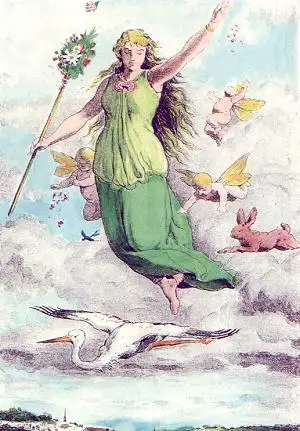
Johannes Gehrts “Ostara” 1890
The implications of east being a sacred direction may extend beyond the tribes which comprised the Anglo-Saxons to other Germanic Tribes. In addition to Jacob Grimm demonstrating that on the European Content a goddess known as Ostara may have been known due to having a month and festival during that month which names cognate directly [Eosturmonath and Eostre : Ostarmonad, Ostara] (J. Grimm Pg.290), there is a passage written by Paul the Deacon about how the Lombards were named in Historia Langobardorum:
“Then Ambri and Assi, leaders of the Vandals, prayed to the god Godan (Wotan) to grant them victory over the Winnili. Godan replied: “I will grant the victory to the first ones that I will see in the morning at sunrise.” Then Gambara and her two sons, Ybor and Aio chief of the Winnili invoked Frea, Godan’s wife, to bring help to the Winnili. Frea advised them to show up at sunrise, and to bring, together with their husbands, even their wives with their hair loose around their faces like beards. At first dawn, while the sun was rising, Frea turned the bed on which her husband slept and turned him to the East, then woke him up. He opened his eyes and saw the Winnili and their wives with their hair loose and gathered around the face like a beard and said: “Who are these long beards?”. So Frea replied, “Just as you gave them a name, grant them victory too.” So it happened that from that moment the Winnili took the name of Lombards.” (Pg. 327-328)
A few things could be going on here: first, Godan/Wotan tells the tribes that who ever wants victory in the battle needs to be the first one seen at sunrise. The Vandals tried asking before sunrise of the next day, but no, it had to be sunrise. Possibly sunrise is a sacred time, a time at which victory is granted or resonates victory. In the previous passage the Saxons conducted their victory ritual during sunrise.
The second thing I’m noticing Godan is looking at the Winnilis— the tribe petitioning him for victory in battle from his east, which means they’re looking at him while he is standing to their west, but isn’t this the opposite of my argument? Petitioning, if not praying to the east?
It appears that way at first, but Frea(Frīge) turned his bed around; in the footnotes of that book:
“Mommsen remarks that Paul has spoiled the instructive story why one does better to put his business in the hands of the wife than of the husband, or rather that he has misunderstood the account. The fable rests upon this, that Godan, according to the position of his bed, looked toward the west upon awakening, and that the Wandals camped on the west side and the Winnili upon the east. The true-hearted god could then appropriately promise victory to his Wandal worshippers in the enigmatical sentence, that he would take the part of those upon whom his eyes should first fall on the morning of the day of the battle; but as his cunning wife turned his bed around, he and his favorites were entrapped thereby.” (Pg 16-17)
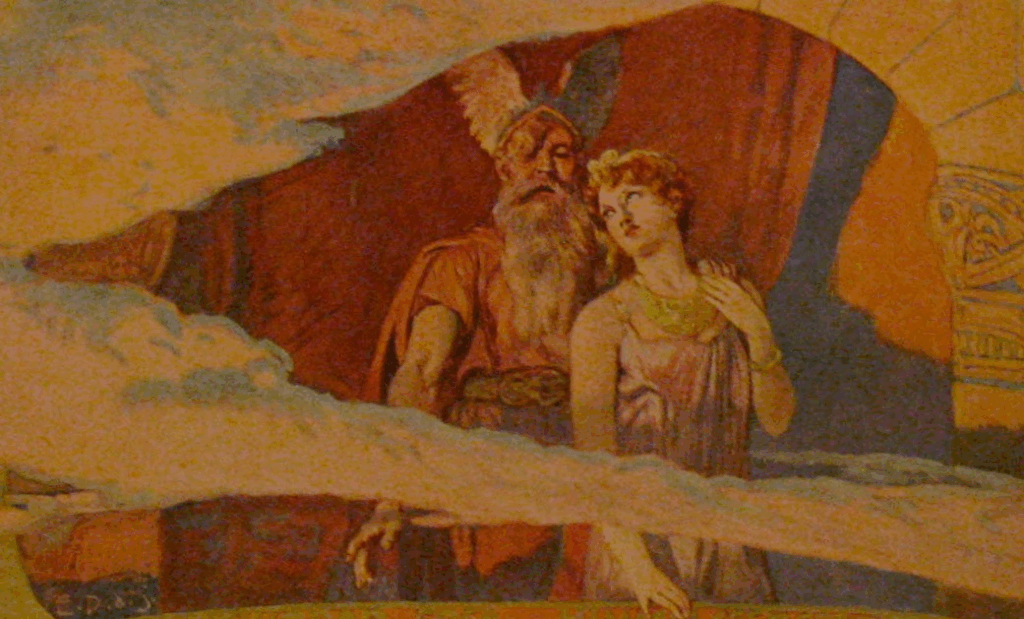
Emil Doepler “Wodan Frea Himmelsfenster” 1905
So, yes, the original idea was that the Vandals were to petition Godan for victory at sunrise who was to be standing to their east, while he would see them to his west. In short the Vandals were to ask (pray by demonstration perhaps) facing east. Only, that didn’t happen because Godan was disoriented and thought he was looking to his West and his worshippers, who he thought were Vandals looking eastwards were in fact Winnilies looking westwards.
As for the Mommsen of the paragraph— Theodore Mommsen was a German classical scholar and Historian. He is widely regarded as one of the greatest classicists of the 19th century, he was also awarded the Nobel Prize in Literature.
Conclusion:
In most cases it is very difficult to determine with certainly which present Christian churches in England were former Heathen Anglo-Saxon temples, in addition there are churches on sites which may date back further than Anglo-Saxon settlement, and the settlers may have repurposed them for their own religious practices (S.Semple Pg. 79-81). Keep in mind Pope Gregory’s advice to retain all existing Heathen structures and convert them over, and the fact that “Christian churches generally face east and the high altar is situated at that end. Some speculate this is because they face the Holy Land of Christ’s birth. That is probably not the reason, in so far as not all point eastwards, and in countries where they would need to point south, west, or north to face the Holy Land, they still predominantly orient east. The more likely explanation is that they greet the rising sun, God’s light for the world, the source of life.”— N. Miller, World History Encyclopaedia
Facing east to pray with an altar situated in the east could very well likely have been a behaviour and a feature that Christianity had an easy time accommodating and repurposing. Praying to the east may have just been a practice Christians already had by the time missionaries met heathens and heathens coincidentally as well had this practice. For the sake of repurposing the practice for the converted heathen: worship and reverence to the sun deity (or any other deity to your east) was transformed into showing reverence to a symbol for the Christian god.
Although I think it’s very likely the heathen Anglo-Saxons prayed to and performed ritual for the gods while facing east, I could change my view in the future depending on what kind of new information is found shedding light on our preconceived notions.
Sources:
St. Bede Historia Ecclesiastica I, 30. Ed Plummer, I. Pg. 65
Russell, J. (1994). The germanization of early medieval christianity: A sociohistorical approach to religious transformation. Oxford University Press.
Storms, G. (1948). Anglo-Saxon Magic. Martinus Nijhoff.
Morris, I. (1992). Death-Ritual and Social Structure in Classical Antiquity Cambridge.
Wilson, D. (1992). Anglo-Saxon Paganism. Routledge.
Bruce-Mitford, R.(1975). The Sutton Hoo Ship-Burial, Volume 1: Excavations, Background, the Ship, Dating and Inventory. London: British Museum Publications.
Widukind, Bachrach, B. S., & Bachrach, D. S. (2018). Deeds of the Saxons. The Catholic University of America Press.
Hauck,K. (1955) “Lebensnormen und Kultmythen in germanischen Stammes- und Herrschergenealogien”, Saeculum 6, pp. 186–223, at 217–18.
Bede, V. (1978). De Temporum Ratione (C. Jones, Ed.; 15th ed.). Brepols.
Sermon, R. (2008). “From Easter to Ostara: the Reinvention of a Pagan Goddess?”. Time and Mind. 1(3): 331–343
Shaw, P. (2011). Pagan goddesses in the early Germanic world : Eostre, Hreda and the cult of matrons. Bristol Classical Press
Grimm, J. (James Steven Stallybrass Trans.) (1882). Teutonic Mythology: Translated from the Fourth Edition with Notes and Appendix Vol. I. London: George Bell and Sons.
Paulus. (1907). History of the langobards paulus diaconus. transl. by W. D. Foulke. Longmans u.a.
Semple, S. (2010). In Open Air (pp. 54–100). essay from Signals of Belief in Early England, Oxbow Books.
Sanmark, A., Semple, S., & Carver, M. (2022). Signals of belief in early England Alex Sanmark. Oxbow Books.
Miller, N. (2024, April). Diversity in Church Architecture in Medieval England. World History Encyclopedia RSS. [https://www.worldhistory.org/article/2426/diversity-in-church-architecture-in-medieval-engla/.]


 Written by
 Written by