 Written by
 by Tom Fernee
Sometimes the discussion about the differences between Anglo-Saxon/ West-Germanic heathenry and Norse Heathenry will develop towards how West-Germanic Vs. Norse tribes viewed the gods differently, and one generalisation may be that the West Germanic “Wodan” had two eyes, whilst the Norse “Odin” had one eye.
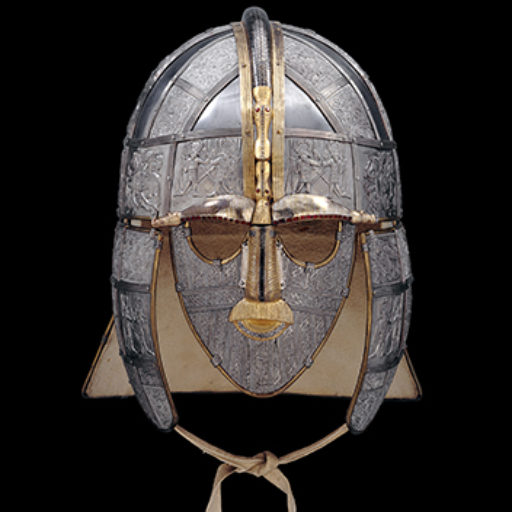
However, when one reviews the archeological finds from the Sutton Hoo burial the distinction becomes murkier. The Sutton Hoo burial was for an Anglo-Saxon King, maybe Rædwald dated to around 625 AD when there were still Heathen beliefs in England. Many Anglo-Saxon kings traced their lineage back to Wodan, and so from the artefact’s of the burial it’s possible there was symbolism within the items the king with which they were buried; the famous Sutton Hoo helmet for example the garnets underneath the boar bristle eyebrow on the right side are backed by gold foils whilst the garnets underneath the eyebrow on the lefthand side are not (An Eye For Odin pg. 520, Mortimer, Price)– this was believed to symbolise the one-eyed nature of Wodan. Imagine a King wearing the ceremonial helmet in a dim hall lit by only fire, the features would be more noticeable– the garnets over the right eye would shimmer, as the garnets over the left eye would appear rather dull (pg.522, Mortimer, Price)
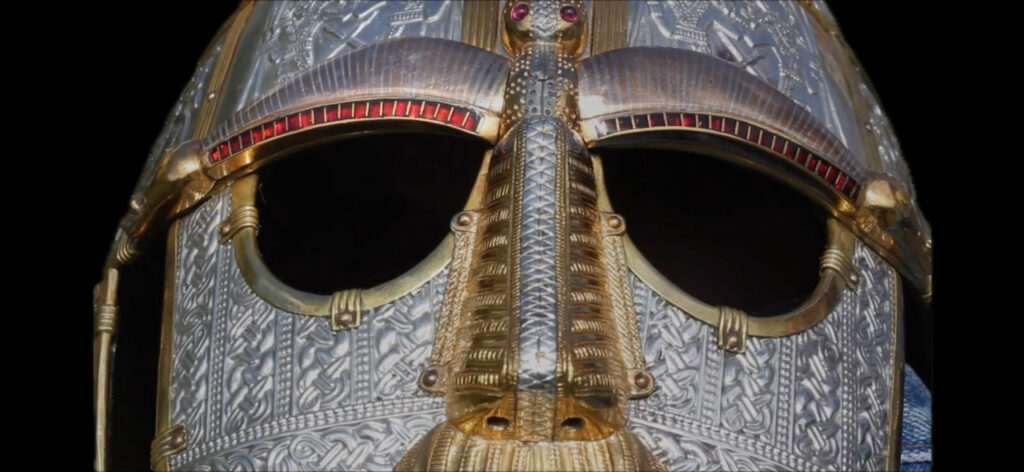
Fig. 1 Sutton Hoo Helmet, replicated by David Roper, by Ande Wick
There are also three other examples from the Sutton Hoo Burial finds that don’t usually get as much attention which also demonstrate Wodan’s one-eyed characteristic– the purse lid garnet mounts, the whetstone, and the garnet-eyes of the animal head terminal in the walu crest of the Sutton Hoo Helmet.
The purse lid of the Sutton Hoo burial features two separate males figures each between two animals, possibly wolves. The figure on the right-side has a gouge mark upon it’s left eye (which is the same side as the helmet) (pg. 528, Mortimer, Price). The whetstone sceptre of the burial features eight faces, one the faces has an alteration to it’s left eye, which has been stricken out and enlarged, making it appear hollow in comparison to the face’s right eye. The whetstone is made of greyscale, a substance which is harder than iron and quite difficult to carve, and therefore no doubt this feature was deliberate (pg.529). As for the garnet-eyes of the animal head terminal in the crest of the Helmet– the left eye is missing a foil, whereas the right eye of the animal head isn’t. (pg.519, 521) Although it’s not as prominent in contrast as the garnets under the helmet’s right-eye it’s interesting to point out that another grave find has a strikingly similar characteristic: the helmet from the Valsgårde grave 7 in Sweden, dated to 620-710 AD– the walu-crest of helmet the proper left eye garnet of the animal terminal above the helmet face is missing a golden foil backing, which expresses the differences between both eyes, along with being of a darker colour garnet making this feature more pronounced, although similar to the Sutton Hoo Helmet (pg.522-523).
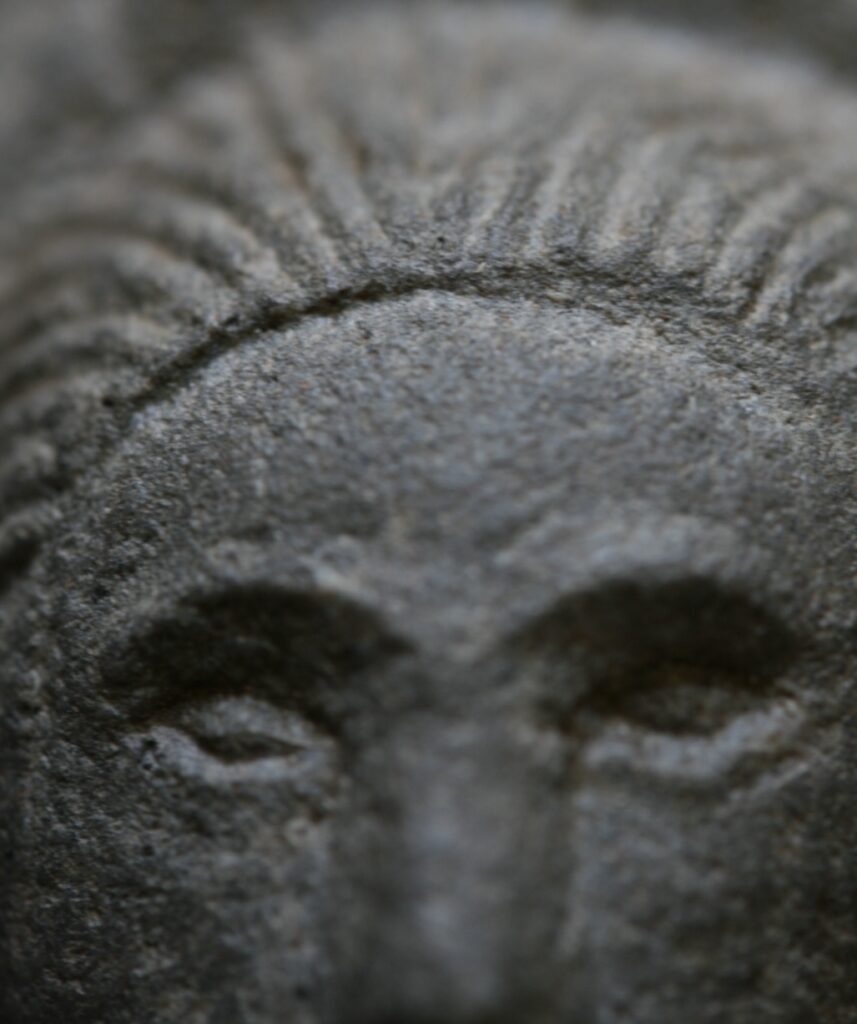
Fig 2. Face B1 of the Whetstone ‘sceptre’ from Sutton Hoo Mound 1. by Hannah Simmons
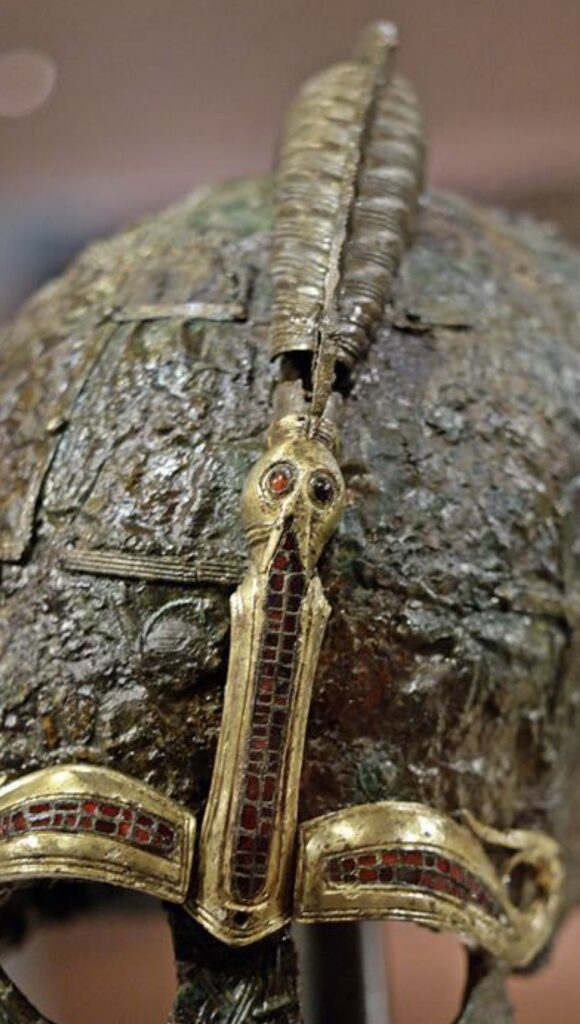
Fig 3. The long animal-head terminal to walu crest on the helmet from Valsgårde grave 7, the mismatch of the eyes of the animal By Lindsay Kerr
Besides the artifacts depicting Woden from the Sutton Hoo burial among other examples in England during heathen times there have been found many Woden Avatars In Numerous Environments or “WAINES” which are maybe pendants, or broaches made of a copper- alloy that feature a two eyed man with two beaked birds on his head that are conical in structure. These protrusions may give the avatar a horned appearance depending on the artist renditions. Several of these are so similar in design which suggest that the makers were using a known pattern. These WAINES found in England are also strikingly similar to the Odin avatars from Scandinavia, which also appear as a head or face wearing the “horned” head-dress, which also appear as conically rendered ravens upon closer inspection. One of which was found from Uppåkra Sweden dating to around the Viking Age with the right eye intentionally struck out (What Colour a God’s Eyes, Mortimer pg. 1-15).Including this example from Uppåkra with the altered eye and the previous example there are a total of 13 finds of an artefact which represent Woden/Odin by alteration of the objects eye (Mortimer, Price pg. 531). Destroying an eye of an item to depict Wodan/Odin seems to have been deliberate act, and not in just Scandinavia or during the Viking Age. Possibly ritualistic in nature.
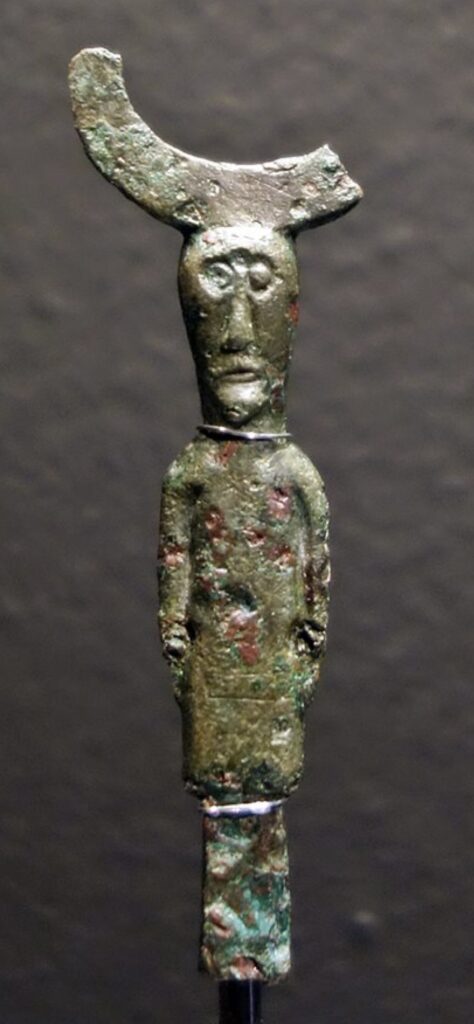
Fig 4. Horned Man Avatar with one altered eye, Uppåkra Sweden, By Matt Bunker and Lund Museum
A 6th century Frankish style silver-gilt belt buckle piece is decorated with a bearded head grooved/carved into the metal and set in niello, possibly to originally depict the face of Christ, but on closer examination the niello fill was deliberately dug out of the left eye groove to appear as an image of Wodan/Odin. This was found in Elsfleth, Germany in an area where heathen Frisians and Saxons would have lived (Odin in Friesland, J. AW Nicolay pg. 510).
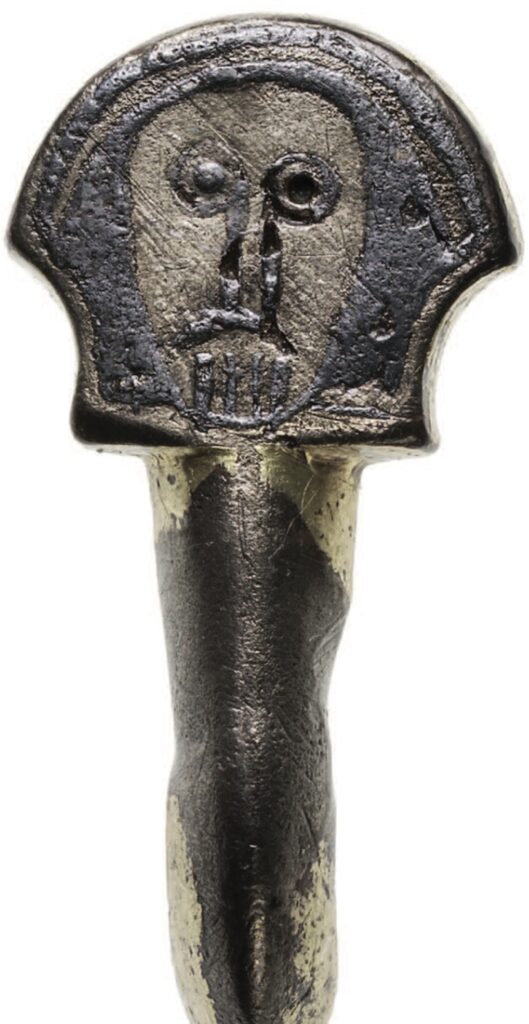
Figure 5.Elsfleth-Hogenkamp. Silver-gilt tongue of a Frankish-type buckle with niello fill removed from left Eye By Niedersachsisches Institut fur historische Kustenforschung, Wilhelmshaven
The furthest back in time the altered eye artefacts go is to about 500 AD, which of course is much earlier than when either of The Eddas were compiled. Could it be the tale of how Odin sacrifices an eye to drink from Mimir’s Well to obtain knowledge is much older than Gylfaginning or the Volúspa, or could it be there were other legends which Wodan sacrifices an eye that were known to the West Germanic Tribes and have yet to be recovered and recorded? The 6th century tends to coincide with the earliest dated golden bracteates of the Germanic Tribes that have been discovered. The most numerous bracteates are the c-types bracteates which depict a profile of a man’s head on top of a horse. The man on these bracteates according to scholar and leading researcher on the subject Karl Hauck is Wodan/Odin, and he is riding Sleipnir (C.Hills pg. 398-401). Whenever there is a depiction of Odin thought to be on these bracteates he is always in profile, and so we are unable to know if the other-side of his face is missing and eye. There is however an A-type bracteate, although in profile likely acknowledging that Wodan/Odin has one eye– bracteate 128b from Nebenstedt, Lower Saxony in Germany, dating to yet again the 6th Century, it’s runic inscription is translated as “One with a gleaming eye consecrates the runes” (Looijenga, Jantina Helena pg. 120). Note, a singular gleaming eye is stated in the inscription. One of Odin’s by-names in Norse Mythology is Báleygr, which means “flaming eye”, for example expresses his ability to terrify with one glance (Pollington, S. Woden: A Historical Companion pg. 423).
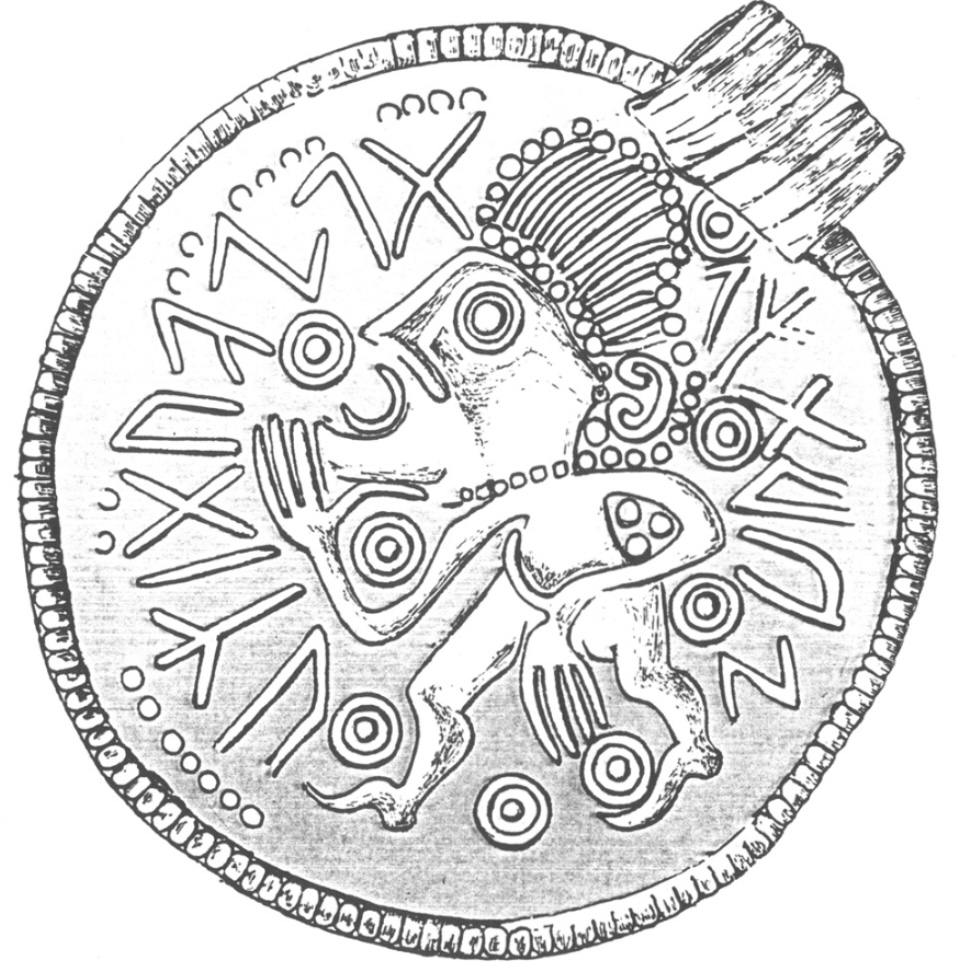
Bracteate IK 128b from Klaus Düwel. “The Inscriptions on Gold-Bracteates and their Relation to Letter and Alphabet Mysticism in the Late Antiue Tradition”. Quaestiones Medii Aevi Novae 23:27-45, Pg. 39
Stephen Pollington in his book Woden: A Historical Companion notes that Odin’s one-eyed characteristic seems to mainly occur when Odin is among people and may adopt a disguise such as a large hat to hide his feature, yet overall when he is among the gods or being described as a god or a king the feature is not noted; in Snorri’s and Saxo’s works the one-eyed feature appears only when the god is interacting with mankind, yet in celestial life he is fair and dignified. Pollington says the key to understanding the iconography of Woden is that the one-eyed feature is dependent on context. (Pollington 418, 419)
However from a heathen perspective with how we understand time, wyrd, and the gods; time is not linear, but rather it is rather cyclical, neither is wyrd linear– although the past and present actions may have bearing on the future there is tendency for wyrd to sometimes “swirl”, that is how we may have believed what was true in the past may only be known in the future as retrospect, so then the future gives us a fresh perspective on the past, and finally regarding the gods, to put it simply: it is possible that the gods may not be subject to a linear time and space continuum. One moment Woden has just one eye, the next he may have both. In conclusion Wodan’s ocular attribute has absolutely nothing to do with whether or not he is being depicted by Anglo-Saxon or the Norse sources as there are many English and Continental sources which also demonstrate Woden with one eye.
Sources:
“An Eye for Odin? Divine Role-Playing in the Age of Sutton Hoo”. Neil Price and Paul Mortimer (European Journal of Archaeology 17 (3) 2014
“What Colour a God’s Eyes”. Paul Mortimer https://blogg.mah.se/historiskastudier/2019/01/30/part-1-what-colour-a-gods-eyes/, 2018
“Odin in Friesland: Scandinavian influences in the southern North Sea area during the Migration and Early Merovingian periods. ” Nicolay, Johan. Interaktion ohne Grenzen: Beispiele archäologischer Forschungen am Beginn des 21. Jahrhunderts. ed. / Berit V. Eriksen; Angelika Abegg-Wigg; Ralf Bleile; Ulf Ickerodt. Vol. 1 Stiftung Schleswig-Holsteinische Landesmuseen, 2017. Pg. 499-514.
“Review of Axboe, M. Die Goldbrakteaten der Volkerwanderungszeit- Herstellungsprobleme und Chronologie”, C.Hills The Numismatic Chronicle 165, Pgs.398-401.
“Runes around the North Sea and the Continent AD 150-700; texts &contexts” by Looijenga, Jantina Helena publsihed by University of Groningen 1997, pg. 120
“Woden: A Historical Companion” – Stephen Pollington, Uppsala Books, London, 2024. Pgs 418-419, Pg. 423
 Written by
Thanks for writing this! Some good insights here.